Home piano lessons 2026: hourly costs, comparison with music schools, the right instrument, and how to find a qualified piano teacher for your child.
Helpful Folks Redaktion
Music and education experts
April 24, 2026
Learning piano at home is the more comfortable, flexible path to the instrument for many families. No rushing from school to the music academy across town, no time pressure for working parents — instead, lessons in familiar surroundings on your own instrument. But what does it actually cost, at what age does it make sense for your child, and what should you look for when choosing a teacher? This article answers the key questions — with concrete prices, practical decision-making guidance, and an honest look at the pros and cons compared to music schools.
The most important advantage of home lessons is time. Anyone who has tried to get a child to a music school across town during the school week knows the problem: school ends at 4 p.m., lesson at 5:30 p.m., travel, waiting, a packed snack, then back home. At least two hours are gone, and the child is often too exhausted in the evening to still practise.
At home, all of that disappears. The teacher comes, your child gets up and walks to the living room, thirty or forty-five minutes later the lesson is over, and the learning atmosphere can flow directly into practice. For working families, this is often the decisive factor that makes piano lessons possible in the first place.
A second, subtler advantage: your child always plays on the same instrument — same keys, same mechanics, same room acoustics. At a music school, the foreign instrument becomes a variable that can cause irritation during home practice. Anyone who learns at home does not have this problem.
That said, there are also arguments for the music academy: public subsidies, vetted teachers, performance experience, and the feeling of being part of a music-making community. The right choice depends on your personal goal — later in the article you'll find a direct comparison.
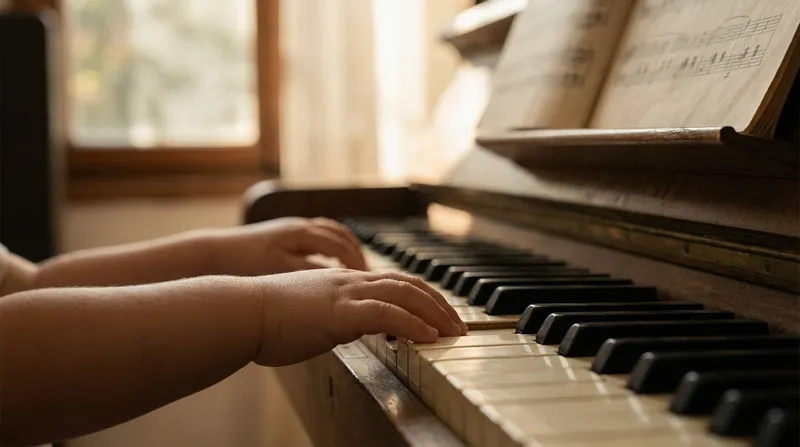
Most piano pedagogues recommend starting at age six, some as early as five. Decisive is not the age itself, but fine motor development and the ability to focus on a task for ten to fifteen minutes.
Concrete prerequisites your child should meet:
Important: the wish must come from the child, not (only) from you. Children pushed into an instrument usually quit after a few months. Better: let the spark emerge on its own, through concerts, listening experiences, or a well-placed instrument in the home.
For children under six, musical early-years education is often the better choice. In groups of four to six children, little ones learn rhythm, pitches and first instrument contact in a playful way, without the demands of private lessons. Many start at three or four and then transition smoothly into piano lessons at six.
Adults can start at any time. Contrary to the myth that piano can only be learned in childhood, numerous studies show that 40-, 50- or 60-year-old beginners master playable pieces within two to three years — provided they practise regularly and have realistic goals.
Prices for piano lessons vary widely by region, teacher qualification and lesson format. Here's an overview of realistic 2026 costs:
| Model | Price | Typical scope | Special note |
|---|---|---|---|
| Public music school | €58-113 / month | 30, 45 or 60 min weekly | Income-based reductions possible |
| Private teacher at your home | €30-40 / 60 min | Flexible, weekly | No travel for your child, travel surcharge applies |
| Private teacher at their studio | €27-35 / 45 min | Weekly | Often slightly cheaper, you drive the child |
| Online lessons via video | €25-45 / 45 min | Flexible | Works well for older students, limited for younger |
The nationwide average price for a piano lesson at home is about €31, with a regional range of €15 to €60. In Munich and Berlin, reputable teachers tend to be at the upper end, while in smaller towns and rural areas lessons are significantly cheaper.
The music school appears more expensive at first glance because it usually bills monthly — €83 per month for a 45-minute lesson sounds like a lot but corresponds to only around €21 per lesson. However, music schools pause completely during school holidays while often still charging for those periods.
Money-saving tip: Many private piano teachers offer sibling discounts of 10 to 20 percent when two children from the same family take lessons. Always ask actively — this is rarely offered automatically.
An often overlooked cost point is the travel surcharge for home lessons. Many teachers charge €3 to €10 per visit for travel, some bill travel time as regular work time. For a 30-minute lesson plus 15 minutes of travel, this can raise the effective hourly price. For teachers who serve multiple students on your street or neighbourhood, this surcharge often disappears entirely.
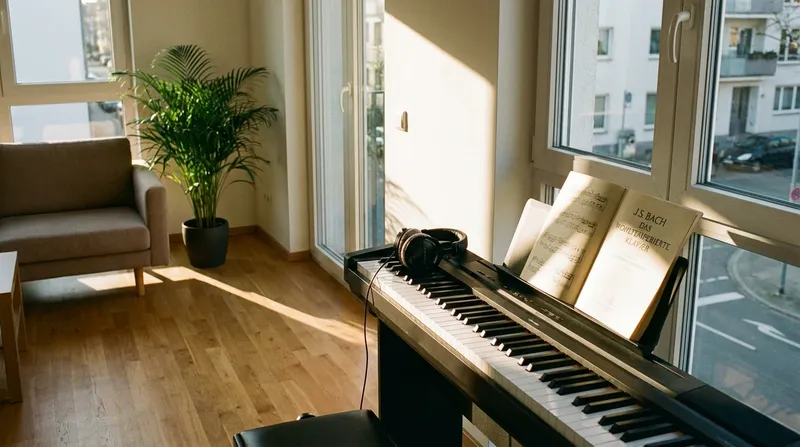
No instrument at home, no lessons. That's the crucial investment many parents stumble over. The three variants at a glance:
Most teachers recommend a good digital piano with 88 hammer-action keys for starters. Those who later commit seriously can always upgrade to an acoustic piano — the digital piano then remains as a secondary or night-practice instrument with headphones.
When buying, watch for three things: 88 keys (not 76 or 61), weighted keys with hammer action (feels like a real piano) and headphone jack (for practice without disturbing neighbours). Three-pedal connection is a plus for advanced learners.
The flow usually follows a proven pattern. A 45-minute appointment breaks down roughly as follows:
With children, the split is more flexible — more playful elements, shorter blocks, songs instead of only études. Good children's teachers mix serious with fun and keep the little ones' concentration span in mind.
Important: the first impression is decisive. During the trial lesson (usually free or at a reduced rate) you should observe how the teacher interacts with your child. Does your child seem relaxed and interested? Or tense and bored? Chemistry and pedagogy matter more here than pure technical brilliance.
An ugly fact from the piano teaching market: the term piano teacher is not protected in Germany. Anyone may call themselves one and offer lessons, regardless of actual training. That makes selection demanding, because you can't rely on titles alone.
Reputable qualifications include:
Without a degree, someone can still be an excellent teacher, especially with years of teaching experience, regular continuing education, and membership in a professional association like the Deutscher Tonkünstlerverband.
Ask during the first meeting:
A teacher who answers these questions professionally and willingly is usually the right choice. Anyone who dodges or feels attacked is probably not the right partner for your child.
On Helpful Folks you find reliable music teachers in your region with transparent profiles and reviews from other families. That saves time over blindly calling three music studios.
Since the pandemic at the latest, online piano lessons via Zoom or similar platforms have become mainstream. The question is no longer whether but for whom it works:
Technically, online lessons work best via Zoom, because audio quality is more adjustable than with Skype. Important are a good microphone (no laptop built-in, but a USB mic from €50), headphones, and a stable internet connection.
The price for online lessons is usually 10 to 20 percent below in-person, because the teacher has no travel and more scheduling flexibility. That makes online lessons often attractive for families on a tight budget — from €25 per 45 minutes with qualified teachers.
Piano lessons without regular practice are like gym membership without training. The lesson sets direction; the progress happens between sessions. This is the part that surprises many parents:
More important than duration is regularity. Six sessions of 20 minutes beats one two-hour session on Sunday. The brain part responsible for finger coordination needs frequent repetition at short intervals, not marathon sessions.
Motivation depends strongly on whether your child feels own successes. Good teachers work with small wins — "look, you can already play 'Twinkle Twinkle Little Star' fluently now" — instead of constantly pointing out deficits. If your child is frustrated after three months and doesn't want to play anymore, it's almost always the teacher or the instrument, not the child.
A practical tip: A dedicated practice area with good light, a comfortable stool, and the piano in a pleasant room position makes a surprising difference. Anyone who first has to clear the room to reach the instrument practises less.
Finding the right teacher is a mix of head and gut decision. Concrete steps:
Important is the notice rule. Good teachers work with 4 to 8 weeks notice per end of month, so they can plan. Contracts with 6-month binding are outdated and should be avoided.
Piano lessons at home have become increasingly attractive in recent years — more flexible, more individual, and for families with tight schedules often the only workable solution. With costs of €25 to €40 per hour with a qualified private teacher, a decent digital piano from €500, and the right starting age from about 6 years, the entry barriers are manageable. The most important investment is not the instrument or the lesson price, but the selection of the right teacher — and their ability to guide your child or you motivatingly through the first months. On Helpful Folks you find qualified music teachers with transparent profiles, reviews and hourly rates. Register for free and find the right piano teacher near you.
Helpful Folks connects you with verified service providers — free and hassle-free.