
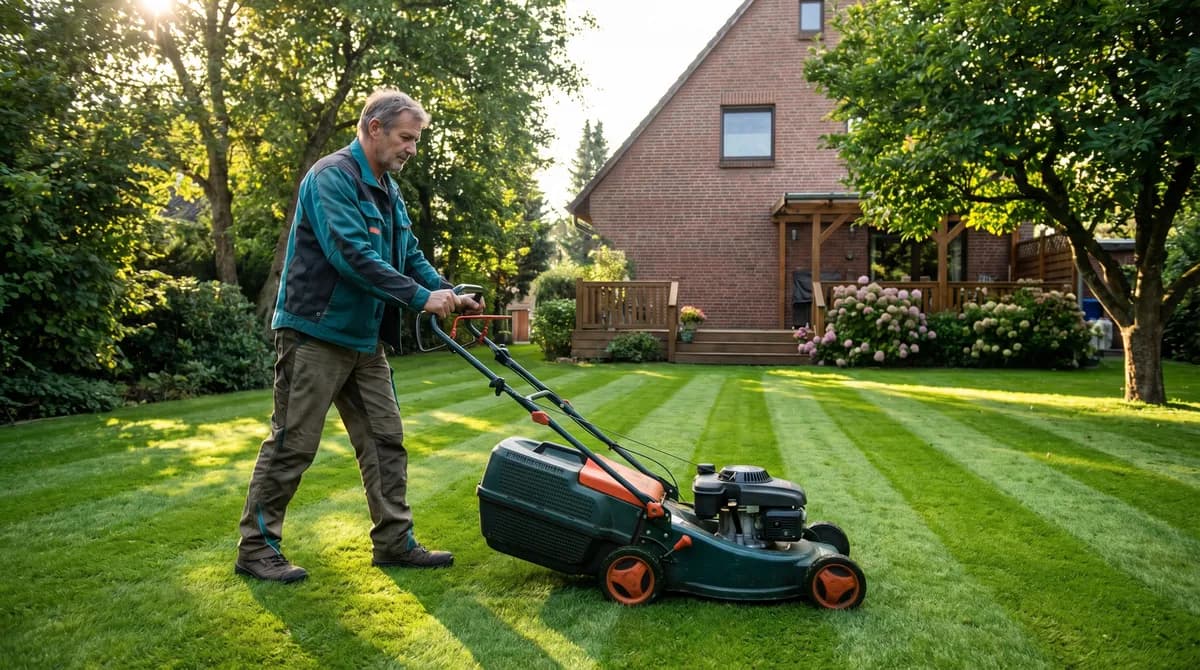
Professional lawn mowing 2026: prices per m² and per hour, comparison with robot mowers, tax tips and selection criteria for a reliable gardener.
Helpful Folks Redaktion
Garden care and household services experts
April 18, 2026
Your own garden is one of the most beautiful recovery sources a household can have — in spring and summer. Until mowing becomes a mandatory appointment: every week, Saturday morning, two to three hours of your free time. Anyone working full-time, with small children or physical limitations, quickly reaches the point of asking: what would it actually cost to have someone else do it? This article gives you the answer with concrete prices per square metre, shows the alternatives, and helps you pick the right service provider.
The classic Saturday lawn mow is a ritual for many — and a nuisance for others. Two to three hours go into each mowing session when you add setup, mowing, edge trimming, clippings disposal and cleanup. In the main season from April to October, that means 25 to 30 mow rounds — around 60 to 90 hours per year.
On top of that are the costs for equipment and maintenance. A solid petrol or battery mower costs €300 to €800 and lasts six to ten years. Tool care, fuel or batteries, sharpening blades, grass catcher bags — over the lifecycle, €1,000 in operating costs per device easily adds up. Those who never want to mow themselves save at least the initial investment.
The third point is often overlooked: a professional mows better. The right cutting height, correct turning technique, clean collection or mulching — all of this decides whether your lawn turns brown in summer or stays green. Anyone who has ever tried to revive a matted lawn after a hot July knows that supposedly cheap DIY work can cost you dearly in the long run.
Costs vary widely depending on garden size, region and lawn condition. The most common billing models are per square metre or per hour. A good overview of prices per m² shows a clear staggering by size:
| Garden size | Price per m² | Example per mowing session |
|---|---|---|
| up to 150 m² | 17-20 cents | €25-30 |
| 150-500 m² | 13-16 cents | €20-80 |
| 500-1,500 m² | 11-14 cents | €55-210 |
| from 1,500 m² | 5-10 cents | €75-150 |
The declining staircase is logical: arrival, equipment setup and disposal happen once, regardless of whether you have 100 or 800 square metres. Large lawns are also often handled with ride-on mowers, which dramatically speeds up the work per m².
On top of that, a travel flat fee of €10 to €50 per job typically applies. That hits especially hard on smaller gardens — with only 100 m² of lawn, the arrival charge practically doubles your costs. In such cases, it pays off to organise neighbourhood group orders or find a provider who regularly serves your district.

Both models have their merits. The hourly rate for lawn mowing is €30 to €40 per hour according to current market data, while specialised gardening businesses also charge €40 to €70. For simple lawn care, €30 to €40 is completely sufficient — higher rates only pay off when additional expertise is needed, such as for scarifying, fertilising or lawn restoration.
The rule of thumb: for standard lawns without obstacles, the square metre price is cheaper and more predictable for you. You know in advance what you pay, and the gardener has no incentive to stretch the work. For difficult terrain (slopes, many trees, narrow paths) that area calculation can hardly capture, the hourly rate is fairer for both sides.
Some providers offer complete flat rates for small to medium gardens — typical are €60 to €120 for a full mow including disposal. That is often the most transparent variant, but when getting a quote, make sure everything really is included: mowing, edge cuts, clippings disposal, arrival. Otherwise you end up with several separate invoices.
Pro tip: Arrange an annual contract for the whole season, not individual jobs. You save between 10 and 20 percent compared to ad-hoc orders, and the gardener plans you firmly into their route tour — that means you have priority when the order book gets tight.
Mowing frequency is the second major cost variable after area. Utility lawns — the normal garden lawn — want to be cut at different frequencies depending on the season:
Over the complete season, that adds up to 25 to 30 mow cycles. Multiplied by €60 to €120 per job (medium-sized garden), you end up at €1,500 to €3,600 per season. A substantial amount, but it covers work that would otherwise cost you 60 to 90 hours of your free time.
Important: Never cut more than one third of the blade length at once. If your lawn has grown too long (holidays, bad weather), have the professional work in two passes — first to 8 cm, then a week later to the target height of 4-5 cm. This protects the lawn and prevents the bleached "patchy pattern" that forms when too much is cut at once.
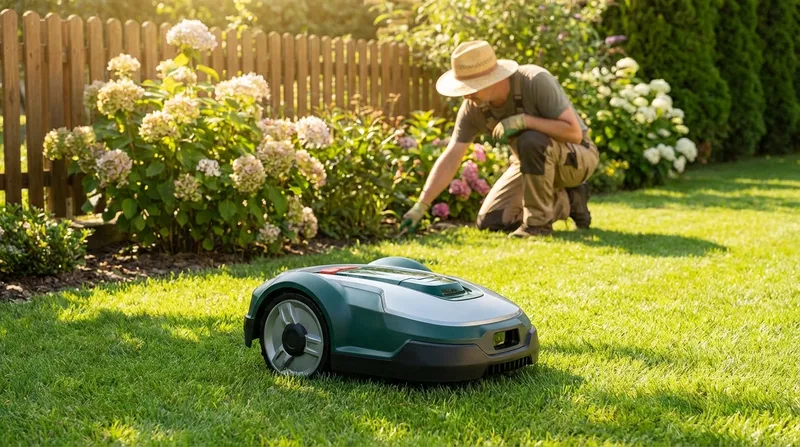
Many garden owners ask whether a robot mower pays off. The calculation depends heavily on garden size, but here is a realistic comparison for a medium garden of 400 square metres over five years:
| Option | Purchase | Annual running costs | Total 5 years | Time spent |
|---|---|---|---|---|
| DIY (petrol mower) | €500 | €80 (fuel, maintenance) | €900 | 75 h / year |
| Robot mower | €1,500 | €50 (power, maintenance) | €1,750 | 5 h / year |
| Pro service | €0 | €1,800 (30 sessions) | €9,000 | 1 h / year (coordination) |
At first glance, the robot mower is the clear winner. But: a robot mower only mows the lawn — not the edges, not the hard-to-reach corners, not the disposal of leaves and weeds. In practice, many households combine a robot mower with a professional for finishing and seasonal extra work like scarifying.
The professional service is the most expensive but also the most time-comfortable variant. If you break down the €9,000 over five years against the 375 hours of working time saved, you arrive at an effective hourly value of €24 that the service saves you. From a net hourly wage of €25 upwards, the professional pays off even mathematically — without the comfort factor at all.
The quality of lawn mowing providers varies enormously. From the professional landscaping company to the weekend moonlighter, everything is on the market. What to watch for:
On Helpful Folks you can find vetted garden helpers in your region with reviews from other customers. That saves you from collecting five quotes through unfamiliar directories and ads.
One last warning: conspicuously low prices (under 5 cents per m² for a single service) are almost always a sign of moonlighting or hidden extra costs. You save in the short term, but are liable for accidents yourself, cannot claim warranty, and get nothing back from the tax office. Reputable providers calculate their price by effort — and that is simply more than 5 cents.
The better you prepare the job, the cheaper it becomes for you and the happier the gardener is. The golden rules:
During the first visit, it pays off to ask the gardener specifically what cutting height they recommend and how often they would mow. A good professional thinks along and actively proposes a season plan — including recommendations for scarifying (once in spring) and reseeding for bald patches. Anyone who immediately quotes the lowest flat price without evaluating your garden situation is probably not a partner you can build on long-term.

Perhaps the most important lever to reduce costs: lawn mowing counts as a household service under German tax law (§ 35a EStG). You can deduct 20 percent of the labour costs directly from your tax liability — up to €4,000 per year. At €1,800 annual cost for the mowing service, you get €360 back.
For this to work, three conditions must be met:
What is deductible:
What is not: lawn seed, fertiliser, edging stones or sod count as materials and are not deductible. So if your gardener also sells you fertiliser, it should be clearly separated on the invoice.
Hiring someone to mow your lawn is not a luxury expense, but a very rational decision for anyone who wants to use their free time differently or can no longer mow physically. With 11 to 20 cents per square metre for a medium garden, fair staggering for large areas, and the 20 percent tax refund, you are in a calculable cost range. The key decision is not "mow or not mow", but "which model fits my garden size and budget". On Helpful Folks you will find qualified garden helpers in your region who handle lawn mowing regularly or on demand — reliably, transparently priced, and with a proper invoice for the tax office.
Helpful Folks connects you with verified service providers — free and hassle-free.