

Spring cleaning made easy: room-by-room checklist, natural cleaning agents, professional help costs and tax tips. Everything you need for 2026.
Helpful Folks Redaktion
Experts in Household and Everyday Services
March 26, 2026
As soon as the first rays of spring sunshine come through your windows, it becomes painfully obvious: dust on the shelves, streaks on the glass, and forgotten corners behind the sofa. Spring cleaning is the perfect opportunity to give your home a thorough deep clean while bringing some fresh order into your daily life. In this article, you will learn how to plan your spring cleaning efficiently, which natural remedies actually work, what professional help costs — and how to get the whole family involved.
Spring cleaning is a long-standing tradition with far more benefits than just a spotless home. After months of spending most of our time indoors during winter, dust, allergens and pollutants accumulate in ways that can genuinely affect our health. A single gram of household dust can harbour up to 10,000 dust mites — and their droppings are among the most common triggers of indoor allergies.
A thorough deep clean noticeably improves indoor air quality. Regularly cleaning carpets, upholstered furniture and curtains significantly reduces exposure to mites, pet dander and pollen. For allergy sufferers, spring cleaning can make the difference between a symptom-free and a miserable season. Mould spores that collect in damp bathroom and kitchen corners are also eliminated during a proper clean — an important contribution to respiratory health.
The psychological benefits are equally significant. A tidy, clean environment measurably lowers stress levels and boosts overall wellbeing. Many people report sleeping better and feeling more balanced after a thorough spring clean. It is also the ideal moment to declutter: clothes that no longer fit, kitchen gadgets gathering dust in the back of a cupboard, or decorations you have long fallen out of love with — all of it can go. Less stuff means less cleaning effort for the rest of the year.
Tip: Use a vacuum cleaner with a HEPA filter. This traps fine dust particles and allergens instead of blowing them back into the room. Textiles such as bed linen and pillowcases should be washed at 60 °C or higher, as dust mites easily survive lower temperatures.

To keep track of everything and make sure nothing gets overlooked, a structured checklist is invaluable. Working through your home room by room lets you see progress quickly and keeps motivation high. Print the list out or save it on your phone so you can tick things off as you go.
A well-thought-out plan saves time, energy and prevents you from getting sidetracked. Follow this guide for a systematic, stress-free spring clean:
Set a date and block out realistic time. Plan for two to four days — everything does not have to happen on a single weekend. Tackling one room per evening during the week works perfectly well and feels far less overwhelming.
Gather all cleaning supplies in advance. Before you start, make sure everything is within reach: all-purpose cleaner, microfibre cloths in different colours, a bucket, a vacuum cleaner with a fresh bag or empty container, bin bags for decluttering, rubber gloves and possibly a steam cleaner.
Declutter before you clean. Go through each room and decisively sort out anything you no longer need. This makes the actual cleaning much easier and creates space at the same time. The tried-and-tested rule: if you have not used, worn or looked at something in over a year, it can go into the donation or disposal pile.
Always work from top to bottom. Start with light fittings, shelf tops and the tops of cupboards before gradually working your way downwards. This way, dust and dirt fall onto surfaces that have not been cleaned yet.
Tackle the most demanding rooms first. Begin with the kitchen and bathroom — these typically require the most effort. Once these two rooms are done, everything else feels noticeably easier and your motivation grows.
Make clever use of soaking times. Spray the oven, shower cubicle or limescaled taps and attend to another task in a different room while you wait. This lets you work in parallel and avoids unnecessary downtime.
Schedule regular breaks. Open the windows, let the fresh spring air in, and enjoy a cup of tea or coffee in between. Hours of non-stop cleaning quickly drains motivation — and thoroughness suffers too.
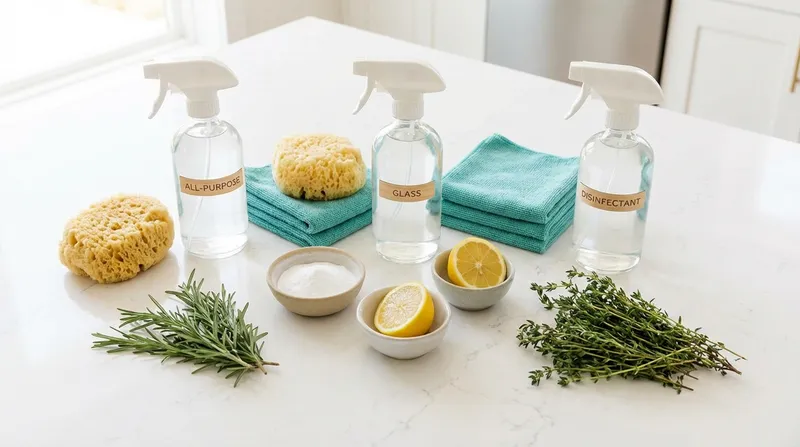
You do not need a whole arsenal of expensive specialist cleaners to make your home sparkle. Four simple household remedies cover almost every cleaning task — and they are environmentally friendly, biodegradable and far cheaper than branded products. The German Federal Environment Agency recommends avoiding aggressive specialist cleaners and relying on tried-and-tested home remedies instead.
| Remedy | Effect | Uses |
|---|---|---|
| Vinegar | Dissolves limescale, mildly antibacterial | Taps, kettle, shower head, tiles |
| Baking soda | Neutralises odours, gently abrasive | Oven, grout, upholstery, carpets, laundry |
| Citric acid | Effective descaler, dissolves urine scale | Toilet, coffee machine, dishwasher, kettle |
| Washing soda | Powerful degreaser, unblocks drains | Hob, extractor hood, drain pipes, barbecue grill |
All-purpose cleaner: Mix one tablespoon of baking soda with one litre of warm water and a squirt of washing-up liquid. This cleaner works on most smooth surfaces around the home — from worktops and door handles to window sills.
Grout cleaner: Stir three tablespoons of baking soda with one tablespoon of water and one teaspoon of vinegar essence into a thick paste. Apply it to discoloured grout with an old toothbrush, leave it for a few hours, and then scrub thoroughly. The results are often remarkable.
Drain cleaner: Pour four tablespoons of washing soda directly into the blocked drain and add a cup of vinegar. The mixture foams up and dissolves grease and soap deposits. After one hour, flush through generously with hot water.
Important: Never use vinegar or citric acid on natural stone, marble or delicate silicone seals — the acid can cause permanent damage. Exercise caution with untreated wood and cement grout as well.
Not everyone has the time or energy to tackle the entire spring clean alone. A household helper via Helpful Folks can take the work off your hands or at least handle the most demanding tasks such as window cleaning, oven scrubbing or deep-cleaning upholstery.
Costs vary depending on the employment model. Here is an overview of current market rates in Germany:
| Employment Model | Hourly Rate (2026) | Details |
|---|---|---|
| Mini-job (privately employed) | €15–18 gross | Easy registration via the Minijob-Zentrale |
| Self-employed cleaner | €15–17 | No social contributions for you, invoice required |
| Cleaning company | €19–25 | Fully insured, cover available if cleaner is ill |
The statutory minimum wage in Germany has been €13.90 per hour since January 2026. The building cleaning sector additionally applies an industry minimum of €15.00 for interior and maintenance cleaning. In major cities like Munich, Hamburg or Frankfurt, actual hourly rates tend towards the upper end of the range, while rural areas generally see lower prices.
For an average 80-square-metre flat, you should expect around three to five hours for a thorough spring clean. With a cleaning company, that works out to between €60 and €125 — a manageable investment, especially if you are pressed for time or prefer to leave certain tasks to the professionals.
Many people are unaware that the cost of household help is tax-deductible in Germany. For a mini-job in a private household, you receive 20 per cent of the expenditure directly back as a tax reduction — up to a maximum of €510 per year. For employees subject to social insurance contributions, the figure rises to as much as €4,000 per year. The only requirement is an invoice and payment by bank transfer. Cash payments are not recognised by the tax office.
Do I really have to clean every room at once? Absolutely not. The most common reason people abandon their spring clean is trying to do everything in a single day. Spread the work across several days and set clear priorities — you will stay motivated and the results will be noticeably better.
Do I need a special cleaner for every surface? No. A good all-purpose cleaner and a vinegar-based cleaner are sufficient for most household surfaces. You rarely need more than four different products. What matters far more is choosing the right cleaner for each surface rather than hoarding an entire shelf of specialist sprays.
Can I simply mix different cleaners together? Never. The combination of chlorine-based cleaners with acidic products in particular can release toxic chlorine gas. Only ever use one product at a time on a surface and ventilate the room well. When in doubt, rinse with plain water before applying a different product.
Can I use vinegar cleaner everywhere? Not on natural stone, marble or untreated wood. Acidic cleaners can cause irreversible damage to these sensitive materials. Lime and cement grout also become porous through regular contact with acid. A useful trick: spray the grout with plain water beforehand — the water film creates a protective barrier.
Does the cleaning order really matter that much? It absolutely does. Anyone who mops the floor first and then dusts the shelves will need to mop the floor all over again. The golden rule is: always work from top to bottom and from back to front. This applies within each individual room as well as to your overall plan.
Should I start with the easiest or the hardest tasks? Begin with the most demanding rooms while your energy and motivation are still fresh. Get the kitchen and bathroom done first — after that, everything else feels like a breeze and you head into the remaining rooms with a sense of achievement.

Doing the spring clean entirely on your own can quickly become exhausting and frustrating. There is no reason to pile all the work onto one person. Children can contribute a surprising amount depending on their age — and they pick up valuable life skills in the process.
Nursery-age children (3–5 years):
Primary school children (6–10 years):
Older children and teenagers (11+):
The most important motivation trick is letting children choose which tasks they want to take on. A personal checklist to tick off creates visible achievements and strengthens their sense of responsibility. Turning up the music, setting a timer or making it into a little competition — with playful elements, the time flies by. And a shared reward at the end, perhaps an ice cream, an outing or a cosy film evening, rounds off the family cleaning day perfectly.
Spring cleaning does not have to be stressful or overwhelming. With thoughtful planning, the right order of attack and a few proven home remedies, you can transform your home into a fresh, inviting haven. Get the whole family involved — it goes faster together and can even be fun. And if you need professional support for the most time-consuming tasks, Helpful Folks makes it quick and easy to find a reliable household helper near you. Browse the listings and start the spring season with a beautifully clean home.
Helpful Folks connects you with verified service providers — free and hassle-free.