
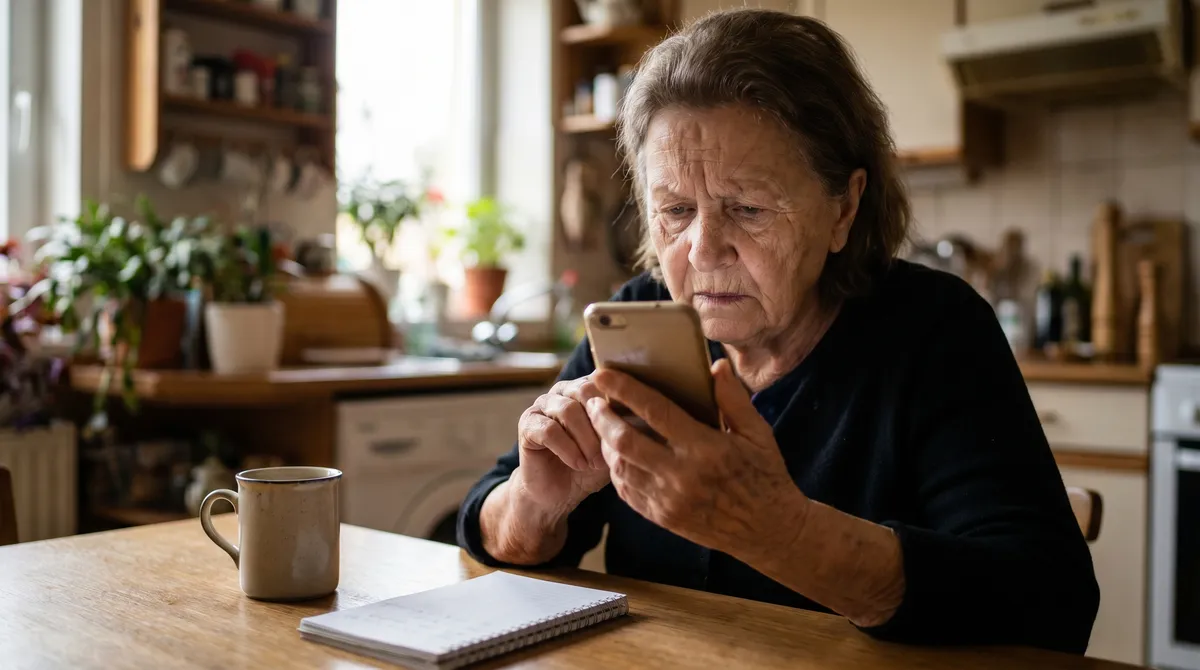
Current 2026 schemes: AI voices, WhatsApp trick, quishing, smishing — the key recognition markers, emergency rules, and protection for your parents.
Helpful Folks Redaktion
Experts for Digital Safety & Seniors
May 7, 2026
In the middle of the night the phone rings. A familiar voice cries: „Grandma, I had an accident, someone is hurt, I need money for bail right away." Sounds unbelievable — happens thousands of times per year in Germany. In 2024 alone, the Federal Criminal Police Office recorded 6,656 cases of the so-called „grandchild trick" and „shock calls" — and that's only the visible side of a statistic with a high dark figure. Damages run into the triple-digit millions, victims are almost always older people, and in 2026 the methods are more sophisticated than ever. AI clones voices from ten seconds of audio, fake WhatsApp messages come from the „daughter's new number", phishing emails look pixel-perfect like your bank's. Anyone with parents or grandparents should use this weekend to talk through the topic calmly.
The classic grandchild trick hasn't disappeared — it has evolved. While German police saw a 50 percent year-over-year drop in 2024, thanks in part to the dismantling of several call centers abroad, perpetrators have since moved to new channels. In January 2026 alone, security authorities registered over 500,000 fraud calls in Germany, causing some 4.8 million euros in damage.
Three trends shape the current threat picture:
First: AI voice cloning. With just a few seconds of audio material — from voice messages, social media videos, or answering machine recordings — perpetrators today generate synthetic voices that deceive even family members. The famous „shock call" no longer feels foreign but perfectly familiar.
Second: Multi-channel strategies. Instead of a single call, attackers coordinate mail, SMS, WhatsApp, and phone. An allegedly encrypted bank email, followed by a „security call" from the supposed employee, followed by an SMS with a confirmation link — that feels convincing because the story is consistent.
Third: High-quality forgeries. The BSI warns in 2026 increasingly of AI-driven phishing waves where criminals use automated tools to imitate large banks and institutions pixel-perfectly. Emails without spelling errors, perfectly formulated SMS, websites visually indistinguishable from the real Sparkasse.
Anyone who taught seniors ten years ago („watch for bad German in emails") needs to teach new rules today. The old recognition cues — typos, awkward phrasing, bad graphics — no longer reliably work. Instead, behavior-based rules need to take over: any phone-based money request is suspicious, any link in an SMS is suspicious, any urgency argument is suspicious. These behavior-oriented rules are more robust because they don't depend on the forgery's quality.
Another observation by security authorities: perpetrators in 2026 increasingly rely on emotional escalation. While earlier calls often began with „This is the police", current schemes feature crying voices, panic-ridden narratives, and threats about „the lawyer" arriving „in five minutes". This stress is meant to shut down rational thinking — and that's why the behavior rules must be simple enough to work under stress.
This overview summarizes what's most often registered in 2026. Anyone recognizing one of these patterns should automatically become suspicious — and hang up or delete immediately.
| Scheme | How it works | Warning signal |
|---|---|---|
| Classic grandchild trick (phone) | „Hi Grandma, guess who?" Money request due to emergency. | Call at unusual time, emergency pathos, money demand |
| Shock call | „Police here, your son had an accident, bail needed" | Pressure, urgency, immediate cash pickup demanded |
| WhatsApp trick | „Hi Mom, I have a new number" + money request | Unknown number messages, immediate money request |
| AI voice call | Cloned grandchild voice with emergency story | Brief connection, alleged urgency, no chance for follow-up |
| Phishing mail/SMS | „Your bank requires security update" with link | Click prompt, urgency, threat of account suspension |
| Quishing (QR code) | Manipulated QR on parking meter or letter | QR code in unexpected place, leads to payment site |
The consumer protection center maintains the Phishing Radar with current warnings, updated weekly — a good habit to check once a month, especially when supporting parents or grandparents.
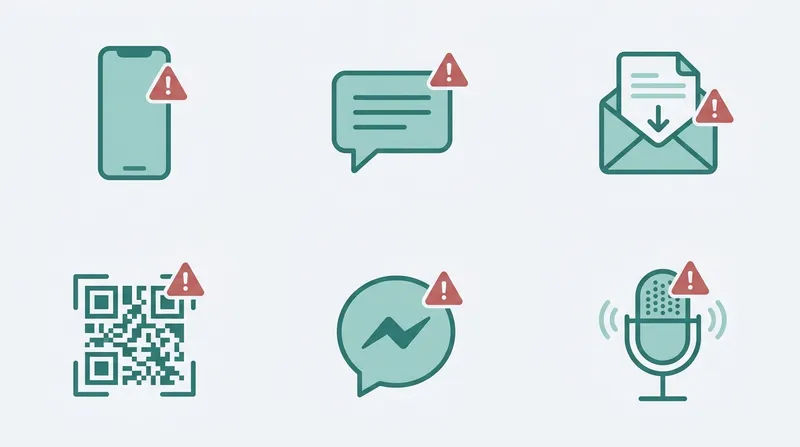
This variant is the most dangerous because it targets the most important human recognition feature: the familiar voice. The process is shockingly simple:
The Bavarian police and the Federal Ministry of the Interior have been warning intensively since early 2026 about this variant because it overwhelms even trained seniors. No one expects a machine to perfectly imitate their own daughter's voice.
What helps: A code word agreed upon within the family. A random word that only family members know — the deceased dog's name, a shared insider, a random number. With every emergency call demanding money, simply ask: „Please tell me our code word." A cloned voice doesn't know it.
A second trick that works surprisingly well: ask a concrete question about shared history that's not publicly findable. „What was the name of the hotel we stayed at in Italy in 2018?" Anyone without an answer or evading is most likely a fraudster. AI voices can imitate well but can't react spontaneously to private family knowledge. Perpetrators have no script for that — they're trained on emergency stories, not small talk.
Third, the simplest of all means: consciously hang up and call back. Even if the voice sounds genuine, calling back the daughter's or grandson's known number unmasks any AI imitation in under 30 seconds. Anyone establishing this as a routine is 99 percent protected against this scheme.
Beyond phone schemes, digital attacks remain mass production. Three variants dominate:
Smishing (SMS phishing). An SMS announces that a package is waiting and €2.99 customs fee is due — please click here. What looks harmless redirects to a fake DHL or DPD page that grabs credit card data. The threshold for small amounts is low, which is why these schemes work so well. Rule: Never click links in SMS. If a package is expected, check directly in the app or on the real provider's website.
Quishing (QR code phishing). Manipulated QR codes are stuck over real ones at parking meters. Anyone scanning and paying hands credit card data to fraudsters. Such codes also appear in letters that allegedly lead to verification. Rule: Treat QR codes on public devices with suspicion, prefer the parking service's app or pay cash. With letters containing QR codes, always check: does the letter look genuine? Could the information also be reached via login on the official website?
Messenger phishing. The BSI warns in 2026 against increasingly polished phishing attempts via Signal, WhatsApp, and Telegram. Here no technical vulnerabilities are exploited — but human willingness to trust. A message from an „IT staffer of the bank" briefly needing help can be the gateway to massive data theft.
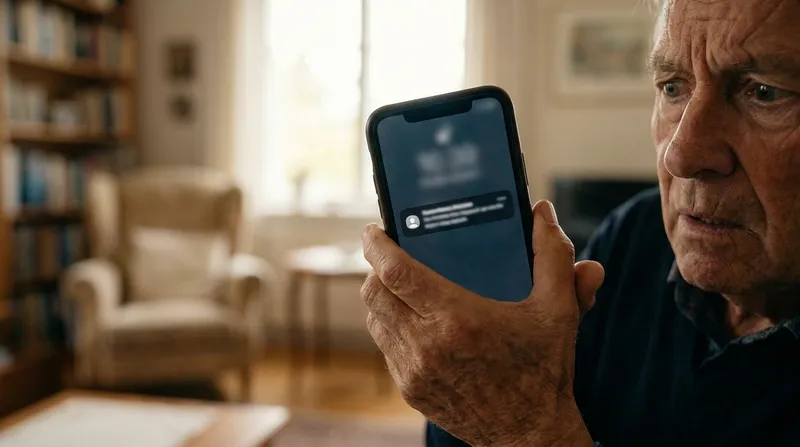
These five rules belong on the fridge — really. They have prevented thousands of damages in practice.
Tip: Print these five rules on an A4 page in large font and hang it next to the parents' phone. That's not patronizing — it's the most effective 30-second defense line that exists.
Online banking itself is very safe today — when the right settings are chosen. These eight steps make a senior's account significantly more resistant to fraud:
For more background on safely using smartphones, banking, and digital services, we've collected resources in our guide on digital help for seniors — also a good entry link if older relatives need fundamental help with smartphone setup.
The most delicate part of this topic isn't the technology — it's the conversation. Anyone alerting parents or grandparents to fraud schemes risks offending them or making them feel they „can no longer manage on their own". That misses the goal.
These three approaches work better in practice than direct lecturing:
Approach 1: Show, don't explain. Let your parents see a real phishing SMS on your phone. „Look what I got yesterday — looks real, doesn't it?" Then analyze together what's suspicious. That's a conversation at eye level, not a lecture.
Approach 2: Invent code words together. Make it a family matter, not „protection for the elderly". Younger family members benefit too — AI voice cloning now affects all age groups.
Approach 3: Offer help with banking configuration. „Let me set up your app so you're warned immediately when someone debits money." That's concrete, helpful, and not condescending.
What doesn't work: scolding or being condescending if parents did click. Guilt feelings cause silence at the next incident — and that's more dangerous than the incident itself.
Approach 4: Routines instead of lectures. Agree on a weekly short call where you casually ask, „has anyone strange called or emailed you this week?" That's not interrogation, it's small talk. But it lowers the threshold for sharing weird calls. Many fraud victims don't speak up out of shame. Anyone lowering the threshold catches many attempts before money flows.
Approach 5: Involve siblings. In families with multiple children, a small task division pays off — one person handles „digital maintenance" (updates, app problems), another „emergencies" (block card, police). Parents then know: in any incident, a clear contact person is available, they don't have to figure out whom to call. This clarity alone reduces stress and significantly speeds reaction time.

If parents or grandparents have already become victims: the first 60 minutes are decisive. This sequence is optimal:
Within the first hour:
Within the first 24 hours:
Long-term:
Important to know: in proven fraud, the bank is liable in many cases — especially when the PushTAN procedure was used in compliance. It pays to be persistent.
If the bank refuses reimbursement, two paths follow: first, file a complaint with the BaFin (Federal Financial Supervisory Authority) — that's free and often leads to a renewed internal review by the bank. Second, call the Banking Association's Arbitration Court, which makes a quick, independent decision. Both procedures are possible without an attorney; both are often successful in practice when the evidence is clear.
An important psychological point: victims of successful fraud bear no guilt — not morally and in many cases not legally either. Perpetrators are professional, often part of organized gangs, and their business is bringing people under stress to wrong decisions. Whoever falls in is a victim, not a failure. This message is needed within the family — and in every conversation with the affected person.
These four addresses are reputable, free, and current:
Anyone needing professional support in everyday life as a family — be it for smartphone setup, secure online banking, or general digital participation — finds helpers in your region on Helpful Folks, patient and personally on-site. That too is effective protection: anyone who can regularly talk to someone about digital questions falls less often for phishing.
Fraud against seniors is more sophisticated than ever in 2026 — AI voices, perfectly faked emails, multi-channel coordinated attacks. But the most effective defense isn't technical, it's human: a code word in the family, a phone-side poster with the five emergency rules, an open conversation without patronizing. Anyone investing an hour as an adult child or grandchild to set up these basics protects parents or grandparents more effectively than any spam filter. Personal support for safe setup is available with helpers on Helpful Folks — directly on-site and in familiar surroundings.
Helpful Folks connects you with verified service providers — free and hassle-free.