

The best Mother's Day gift for caregiving mothers is relief — not flowers. 10 high-impact gift ideas plus how to use the €131 monthly relief allowance.
Helpful Folks Redaktion
Experts for Care & Everyday Services
May 3, 2026
Flowers wilt, chocolates are gone by Wednesday — and the laundry pile keeps growing. If your mother is a caregiver, the most valuable Mother's Day gift isn't wrapped in ribbon — it's relief. Whether she's caring for someone, being cared for herself, or juggling both at once, 2026 offers more options than ever to give her real recovery: from a paid hour of household help to government-funded care budgets. We'll show you what actually lands, what to avoid, and how you can save taxes along the way.
A recent Mother's Day study puts it bluntly: 39 percent of all mothers wish to do nothing on this day — no organizing, no planning, no taking care of anyone. For 67 percent, an honest "thank you" is enough. Few expect grand gestures or expensive presents.
For caregiving mothers, this picture intensifies. Anyone who balances a job with caring for their own mother or supporting a child with special needs rarely has time for themselves. What they really need isn't things — it's hours during which someone else takes responsibility. That's exactly what makes a good Mother's Day gift in a caregiving context: it buys her time back.
This is also a cultural shift. While the classic tradition consists of a bouquet and breakfast in bed, the trend in 2026 is clearly moving toward "gifting care services". A voucher for household help, a prepaid grocery service, or an hour of companionship are the new categories — and they show more thoughtfulness than any wellness basket.
The numbers tell a clear story: between 60 and 80 percent of family caregivers in Germany are women, more than 70 percent of those needing care at home are looked after by women. In recent surveys, around 70 percent of caregivers report feeling strongly or very strongly burdened. Six in ten describe constant availability and lack of rest as severely stressful. Half fear they'll get sick themselves over the long term.

Behind these numbers is a daily routine almost no one truly imagines: up at 5:30, wash mom, breakfast, kids to school, work, lunch break at mom's place, medication, pharmacy, evening cooking, laundry, paperwork for the care insurance — and then the call at 11 PM because mom has fallen. For months. For years.
Experts now warn of a silent burnout crisis among family caregivers. Symptoms creep in: chronic fatigue, irritability, social withdrawal, the feeling of "no longer functioning". Many affected women neglect their own checkups, sleep less than six hours a night, and lose contact with friends over the course of months. When outsiders ask "how are you?", the answer is reliably "all good" — even when the opposite is true.
What reminds these mothers that they're human beings and not just functions: an afternoon at a café, a massage without time pressure, a weekend without obligations. All of this requires someone else to take over. That's exactly where effective gifts come in. It's also why a "wellness voucher" alone often isn't enough: if mom goes for a massage but mentally keeps organizing who picks up grandma at 2 PM, she's consumed a gift but had no break. Real relief requires a double movement — she needs to step out, and someone else needs to step in.
This overview is sorted by impact — from quick acute relief to long-term structural support. Prices reflect realistic 2026 market rates.
| Gift | What it does | Price range |
|---|---|---|
| Household help voucher (4 hrs) | Cleaning, laundry, ironing — done in one go | €60–100 |
| Grocery delivery subscription (4 weeks) | Weekly grocery shopping, delivered | €80–160 |
| Companion service (1 day) | Walk, doctor appointment, coffee — quality time | €80–120 |
| Ironing service (monthly package) | Laundry pickup, ironed and returned | €40–80 |
| Window cleaning voucher | The seasonal task no one wants | €80–150 |
| Garden care appointment | Mowing, hedge, beds done once | €80–200 |
| Wellness day with parallel childcare | Spa plus care for the dependent | €150–250 |
| Substitute care (1 day) | She can leave entirely, someone else covers | €100–250 |
| Driver service package (5 trips) | Doctor, pharmacy, errands without stress | €100–200 |
| Meal delivery stock (4 weeks) | Weekly food box at the door | €200–350 |
Important: a voucher must not become a hurdle. If your mother still has to find someone, call them, and coordinate appointments, you've gifted her work, not relief. The best caregiving gifts are "done-for-you" — you book, you organize, you hand over the finished appointment.
From the experiences of many caregiving daughters and sons, two patterns emerge: gifts work better the less cognitive load they pass on to the recipient, and they work longer the more they reshape daily routines. A single cleaning appointment is nice, but weekly household help over three months is transformative. If your budget is limited, choose smaller recurring sessions over a one-off — four one-hour companion visits beat a single 200-euro spa day that ends after three hours.
Gifting household help on Mother's Day sounds simple but often falls apart in execution. These five steps get it right:
Tip: If your mother is suspicious of strangers in her home, offer to be there for the first visit. This dramatically lowers the barrier and turns the gift into a shared experience.
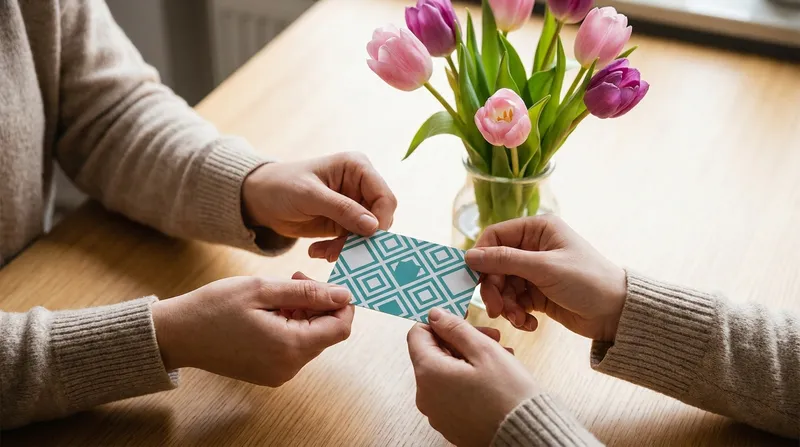
When Mother's Day celebrates a mother who is herself in need of care, the gift focus shifts. It's no longer about relieving the mother — it's about dignity, comfort, and participation. The following gifts tend to be especially well received:
What to avoid: makeup sets if she no longer wears any. Books if her eyesight is fading. Tea selections if she has trouble swallowing. It sounds obvious but happens constantly because gifts are often chosen from the giver's perspective rather than the recipient's.
Here's an aspect many people miss: if your mother has a care level — even just care level 1 — she's entitled to €131 per month as a relief allowance. That adds up to €1,572 per calendar year, and the money is earmarked for exactly the kind of services we've been discussing: household help, companion services, day care.

Concretely: if you give your mother a household-help voucher worth €100, she can recover those €100 from her care insurance via the relief allowance — provided the provider is recognized under state law. Your gift effectively becomes a money generator: €100 gift, €100 plus from the insurance, and your mother can afford a second round.
A concrete example: mom has care level 2. You give her a four-session household-help package worth €320 through a recognized provider for Mother's Day. She submits the invoice to her care insurance and gets the €320 fully reimbursed via the relief allowance — paid from her annual budget of €1,572. The gift effectively cost her nothing, you invested €320 once, and the remaining €1,252 per year is still available. Once you understand the mechanism, you can repeat it every year — and you systematically use funds that would otherwise expire unused.
Important deadline: unused amounts from 2025 expire on June 30, 2026, irrevocably. So anyone with leftover credit from last year should start using it now at the latest — and Mother's Day is an ideal trigger.
Substitute care is another hidden gift budget. Since the care reform, €3,539 per year are available for it — combined with the short-term care budget. That's enough to fund a weekend including substitute care if your mother is the one providing care and needs to step away entirely. More on this in our guide to home care and relief.
A few pitfalls that can come up around care gifts:
In families with multiple siblings, care duties are usually unevenly distributed — typically one daughter shoulders the main load while others are geographically or temporally distant. Mother's Day is a good occasion to address this on equal footing, without accusations.
A proven idea: set up a shared care budget. Three siblings each chip in €50 a month into a pot used exclusively for relief services for the caregiving sister (or mother). It funds a weekly household helper or a monthly time-out. Instead of a one-off €150 voucher on Mother's Day, this creates a lasting structure.
Those who don't want to set up an ongoing budget can use Mother's Day as a "joint gift" anchor: three people co-finance a wellness weekend with substitute care — one pays the hotel night, another the spa program, the third the short-term care for the dependent person. The weekend becomes not only affordable but psychologically lighter: mom doesn't need to "feel guilty toward a sibling" because the gift is distributed.
Crucially, have the conversation early — not on May 9. With two weeks of lead time, professional substitute care is easy to book. Spontaneity rarely works in caregiving.
There's a Mother's Day aspect rarely discussed: some caregiving women experience the day as additional pressure. Expectations about family visits, their own mothers needing care in turn, a day of sentimentality in a daily life that has no room for sentimentality.
If you sense Mother's Day creates more pressure than joy for your mother, then the best gift might be an honest conversation: "What would actually help you? Even if it sounds unromantic." Some mothers wish for a day when no one comes, the phone stays silent, and the couch is theirs for six hours. That's also a gift — and sometimes the most valuable one.
Exhaustion in caregiving isn't a personal failure but a consequence of structural pressure. Anyone who takes that pressure seriously and addresses it at the root — through lasting relief, professional help, honest communication — gives more than any bouquet. Platforms like Helpful Folks help find the right person for the right need, whether one-off or ongoing.
Speaking of which, take a moment to consider what you, the giver, are doing. Anyone worrying about a caregiving mother is indirectly carrying part of her mental load — even if you live far away. An honestly framed question like "what can I take off your plate that actually saves you work?" is more than a gift: it's a relationship offer. And sometimes the answer is: "call once a week without me having to ask." That costs nothing and is still the most valuable Mother's Day gift you can give.
The most beautiful Mother's Day for a caregiving mother is the one where she has to do nothing. A well-planned care gift — whether household help, grocery service, or companion time — creates exactly that. If you cleverly include the state relief funds like the €131 relief allowance and substitute care, your gesture becomes doubly effective help: emotionally felt, financially manageable, lastingly relieving. You can find a suitable helper in your region on Helpful Folks — bookable in minutes and right in time for May 10.
Helpful Folks connects you with verified service providers — free and hassle-free.