Private lessons, VHS, or app? Cost comparison, what research says about pace, and how to reach B2 in 470 hours — the complete guide.
Helpful Folks Redaktion
Experts for Education & Language Learning
May 5, 2026
Finally fluent in English, Spanish for the trip to Madrid, French for career boost — the list of good reasons to learn a new language is long. What actually happens in everyday life often looks different: an app on the phone, three motivated weeks, then a pause. The reason rarely lies in willpower but almost always in the chosen method. Anyone deciding in 2026 to truly learn a language faces three main options: private one-to-one lessons, a classic group course at a language school or adult education center, or a combination of app and online tutoring. Each variant has clear strengths and equally clear weaknesses. Those who find the right path don't just learn faster — they also stick with it.
The market has differentiated significantly in recent years. Anyone tackling a foreign language today chooses between three fundamentally different models.
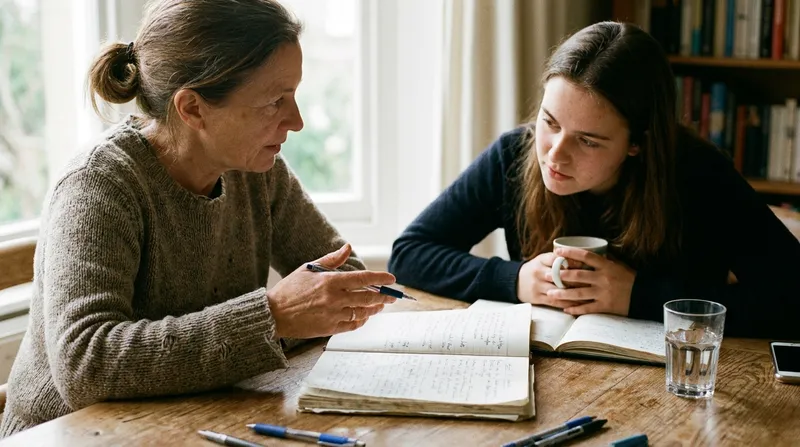
First, private language lessons. One teacher, one student, classically at home or online via Zoom or Teams. Sessions are fully tailored to individual level and personal goals. Platforms like Superprof, Preply, italki, or Verbalplanet match qualified teachers within minutes — many offer a free trial lesson as an entry option.
Second, language schools or adult education centers (Volkshochschule). Classic group courses, usually with 8–14 participants, fixed schedules, structured curricula across CEFR levels. The Volkshochschulen are the largest provider in Germany — low prices, neighborhood availability, programs covering Italian, Spanish, Turkish, Mandarin and beyond the standard languages. Alongside that, commercial schools like Berlitz, Inlingua, or GLS sit in the premium segment.
Third, app-based solutions. Babbel, Duolingo, Busuu, Tandem — they promise learning whenever you want, often for under €10 per month. Compared to the other options, they deliver less depth but maximum flexibility. Today, hybrid models are the standard: an app for daily vocabulary drilling plus a weekly live session with a teacher.
Which variant suits you depends on four factors: your target level, the time frame, your budget, and your learning style. Let's look at the differences concretely.
Prices vary dramatically — an hour of private language lessons can cost anywhere from €18 to €80, depending on language, region, and qualification. This overview shows realistic 2026 market values:
| Format | Price per hour / course | When it makes sense |
|---|---|---|
| Private lessons (60 min, online) | €18–35 (Superprof, Preply) | Specific goals, flexible schedule |
| Private lessons (60 min, in-person) | €30–50 (regional differences) | When personal contact is central |
| Business private lessons (60 min) | €50–80 (specialized teachers) | Business English, negotiation language |
| VHS group course (10–15 sessions) | €80–180 total | Solid base, beginner level, budget |
| Premium language school (intensive) | €400–1,200 | Job-required B1/B2 in 4–6 weeks |
| Online language school (Lingoda etc.) | €80–250 per month | Structured program, fixed dates |
| Language app (Babbel, Busuu) | €6–13 per month | Vocabulary, grammar basics, commute |
On average, private language teachers in Germany charge €35 for a 60-minute session regardless of the language taught. Important context: the price covers not just the teaching itself but also preparation, follow-up work, and for in-person sessions often the commute. Whoever calculates as „pure hourly rate" misses the picture.
VHS courses are by far the cheapest serious option. A typical English beginner course at the VHS with 15 double sessions costs between €100 and €150 in most German states — that's less than €5 per teaching hour.

Common sense says: one-to-one lessons must lead faster to the goal because the teacher focuses exclusively on one person. Science confirms this — but with nuance.
A University of Maryland study shows that learners in one-to-one lessons can make up to 40 percent faster progress on specific language goals compared to heterogeneous groups. A meta-analysis by Lee and VanPatten further demonstrates that direct correction and individual feedback in 1:1 formats lead to significantly higher language accuracy.
But the research doesn't unilaterally favor private lessons: the Foreign Service Institute of the USA — one of the toughest language schools in the world — sees the sweet spot in small groups. Four to six learners at comparable levels, with a clearly structured curriculum, are often more effective than pure 1:1. The reason: language is always also social. Anyone speaking only with the teacher misses the practice of free conversation with peers — and thus a central competence.
What does this mean? Two rules of thumb:
The Volkshochschule is significantly better than its reputation. Anyone seeking a classic group course finds a thought-out, level-based system here: A1 for absolute beginners, A2 for basic knowledge, B1 for independent language use. Teachers are typically pedagogically trained and often have years of experience. Language courses are a central pillar of every VHS program — fair prices, broad offerings, neighborhood availability.
A language school or VHS is right for you if:
The honest weaknesses: rigid pace that may not match your individual level; appointments that may clash with work or family; teachers you can't choose. If the course doesn't fit, switching is cumbersome.
Private 1:1 instruction is the more expensive option per hour. But on closer inspection of efficiency, the calculation often tips toward private lessons. Whoever reaches B1 in 30 private hours may have spent less than someone needing 60 VHS hours for the same goal. Hourly costs are higher, output per hour is too.
Private lessons are clearly the better choice if:
Tip: If you're unsure, simply book three trial lessons with different teachers. The investment is between €0 and €100 and is by far the best way to feel whether the chemistry works and the format fits. The same applies to other one-to-one formats — we showed this in detail in our article on piano lessons at home.
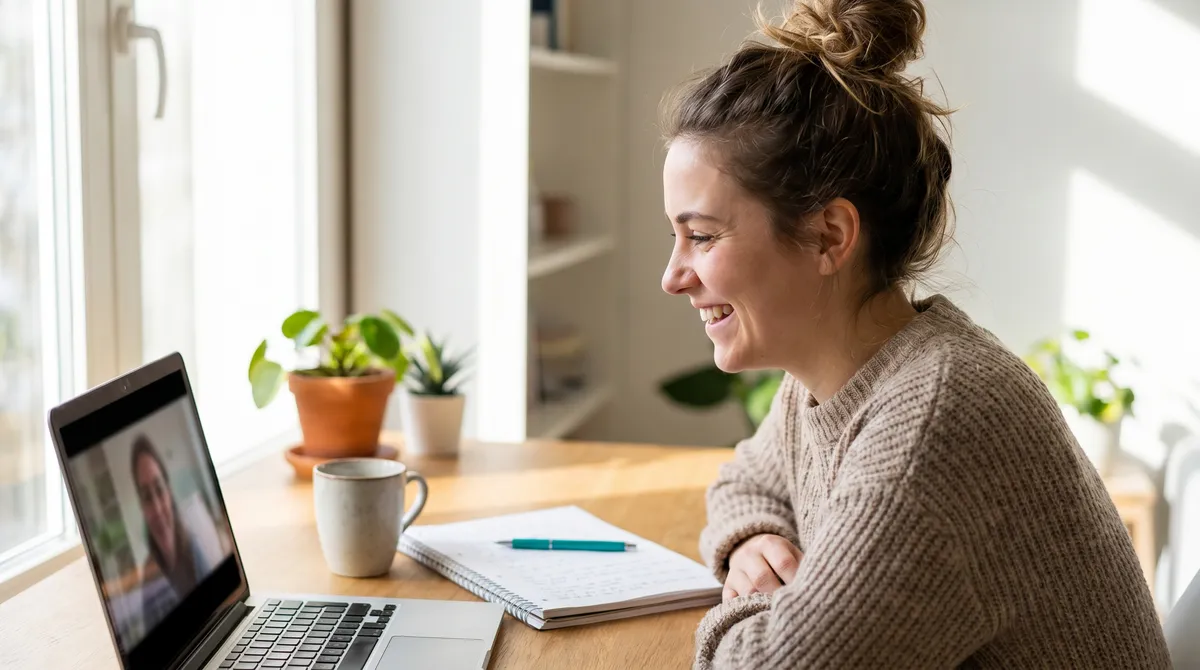
Ten years ago, online language teaching was a stopgap. Today, it's the main format for many. Platforms like Preply, italki, Lingoda, and Verbalplanet connect learners with tens of thousands of qualified tutors worldwide. Live video instruction is barely distinguishable from in-person — and the commute disappears, the teacher pool is huge, and prices are usually 20–30 percent below in-person rates.
Key platforms at a glance:
In practice: most successful learners combine. An app for daily 10 minutes of vocabulary, once a week a 60-minute live session with a tutor, occasionally a conversation tandem with a native speaker. This combination is cheaper and more effective than any single method.
App-only use rarely takes you beyond A2. Apps are excellent for vocabulary, grammar basics, and listening — but free speaking is only learned by speaking. With real humans.
A new trend that can no longer be ignored in 2026: AI-based conversation partners. Tools like Speak, Talkpal, or the conversation modes in Babbel and Mondly offer endless speaking practice with synthetic conversation partners. For absolute beginners and people with speaking inhibitions, these tools are a real win — they don't judge, they have infinite patience, they're available 24/7. But they don't replace a teacher because they don't structure learning paths and don't recognize didactic weaknesses. As a complement between live sessions, they work excellently.
One of the most frequent questions: „How long do I need?" The answer comes from the Common European Framework of Reference for Languages (CEFR), which estimates learning time per level realistically.
| Level | Learning hours (additional) | What you can do |
|---|---|---|
| A1 | 70–90 hrs | Introduce yourself, simple everyday phrases |
| A2 | +90–100 hrs | Familiar topics, simple conversations |
| B1 | +130–150 hrs | Travel, work in familiar areas, opinions |
| B2 | +180–200 hrs | Fluent in complex conversations, professional use |
| C1 | +180–260 hrs | Advanced, professionally nearly unrestricted |
| C2 | +260–400 hrs | Near-native |
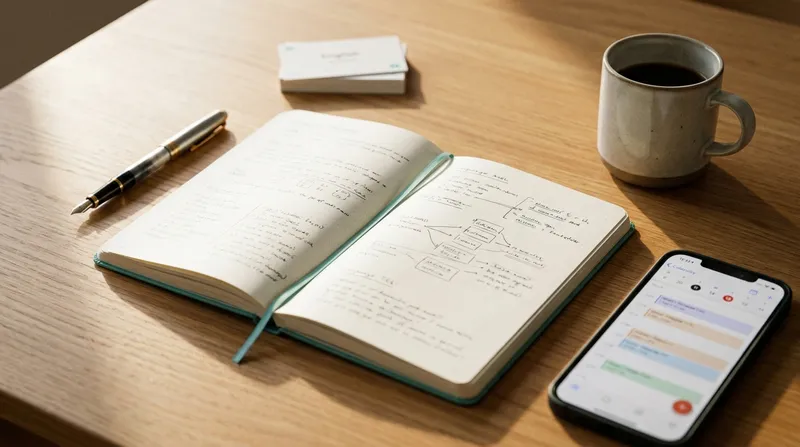
That's a total of between 470 and 540 hours from absolute beginning to B2 — roughly three to four years if you invest 3 hours per week. Sounds like a lot? It's the reality of any serious language. Anyone promising you'll speak fluent Spanish in 3 months is selling an illusion. What works: travel-Spanish (A1–A2) for relaxed holiday communication in 3 months. That's already a lot — and absolutely doable.
An important point on learning speed: languages like Spanish, Italian, or Dutch are significantly faster for German speakers to acquire than Russian, Arabic, or Mandarin. The US State Department classifies languages for English speakers in four difficulty categories — a rough orientation that works analogously for German speakers. Romance languages sit in the easiest category, while Mandarin and Japanese require three to four times the learning time. Anyone targeting Mandarin at B2 should realistically count on 1,500+ hours.
Practically: set milestone goals in language levels, not in „I want to be fluent". An honest roadmap might look like — first 6 months: solid A2. Months 7–18: B1 in conversation and writing. Then targeted B2 for professional or personal use. This staging prevents frustration because you regularly see tangible progress instead of stagnating in „still not fluent" mode.
If you decide on private lessons, choosing the teacher is decisive. These six criteria separate the wheat from the chaff:
On Helpful Folks you'll find language teachers in your region or online — with transparent pricing, reviews, and detailed profiles, so you can filter well in advance. The path to becoming a teacher yourself is also viable: in our guide for tutors we explain how to set this up legally and tax-wise — much of it applies analogously to language teachers.
Most language-learning failures have less to do with method and more with expectations. These six mistakes appear especially often:
Mistake 1: Too much at once. Three languages in parallel, an hour daily — won't last three weeks. One language, clearly focused, regular over intensive.
Mistake 2: Using the app as the main method. Apps are excellent supplements but rarely main methods. Anyone learning only with Babbel rarely gets beyond passive understanding.
Mistake 3: Choosing the wrong teacher out of likability. A nice teacher you enjoy but don't progress with isn't right either. The question is: am I learning, do I feel progress? If no — switch.
Mistake 4: Misjudging the level goal. Some want to speak „fluent" and actually mean B1 (independent use). Others need B2 for the job and self-assess at B1. Clarity about your own goal saves frustration and time.
Mistake 5: Treating a pause as the end. Anyone pausing two weeks hasn't „lost" the language. Anyone pausing three months restarts at a much higher level than the first start. Languages are capital — even with pauses, most stays.
Mistake 6: Wrong time for method switches. Many learners switch too early because three weeks haven't delivered the hoped-for progress. Language learning is non-linear — phases of apparent stagnation often precede breakthroughs. Whoever switches teacher, app, or school every four weeks spends more time on adjustment than on actual learning. Three months is the minimum window to fairly evaluate a method.
If you learn a language for professional reasons, you can often claim costs as work-related expenses or business expenses. The condition: a clear professional connection. A salesperson serving international clients improving English has an easy case. Hobby Spanish for the trip — no. Keep all receipts: invoices from the teacher or school, attendance certificates, a brief note on the professional link. The flat allowance of €1,230 is quickly exceeded when you take regular private lessons, so collecting pays off. For the self-employed it's even cleaner: language instruction for professional activity is normal business expense and reduces the tax base directly.
There isn't one right method for learning a language — there's the right method for you. Anyone wanting Spanish for travel and enjoying social group learning is best served at the VHS. Anyone needing professional B2 in four months should invest in private online lessons. Most learners do best with a combination of app, weekly live session, and occasional tandem — affordable, effective, sustainable. You can find a suitable teacher on Helpful Folks — from English to Spanish to rarer languages, with transparent pricing and uncomplicated booking.
Helpful Folks connects you with verified service providers — free and hassle-free.