
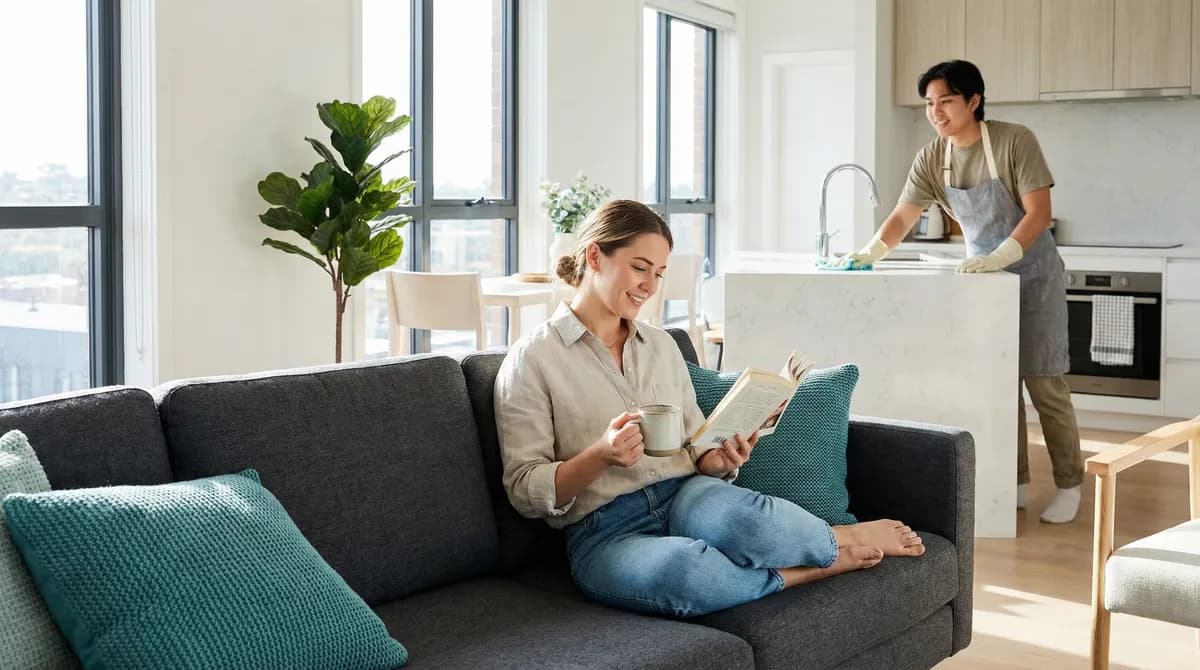
More and more young people are getting help around the house. Why it is not a luxury, what it costs and how to save on taxes.
Helpful Folks Redaktion
Experts in Household Help and Everyday Services
March 31, 2026
Cleaning, doing laundry, shopping, tidying up — on average, women in Germany spend over 13 hours per week on housework, men around 6.5 hours. That adds up to hundreds of hours a year that could go towards hobbies, family, rest or a career. No wonder that more and more people — particularly younger generations — are saying: it does not have to be this way. In this article, you will learn why household help is no longer a luxury, what it costs, which tax benefits you can use and why it may actually save you money.
Housework is more than just dusting and washing dishes. Behind it lies a complex system of planning, organisation and execution that experts call mental load. Who remembers the laundry needs doing? Who plans the weekly shop? Who notices the cleaning supplies have run out? In 62 per cent of partnerships, it is primarily the woman who takes on this invisible organisational work — even when both partners work full time.
The consequences are measurable: 62 per cent of mothers feel severely burdened by mental load. Mothers report physical complaints and nervous tension significantly more often than fathers. Telling, too, is the perception gap: while around 68 per cent of men believe the housework is shared fairly, only 44 per cent of women agree.
In an era where work-life balance has become a central life value, a simple question arises: why do you do a job yourself that drains you, that you dislike and that someone else could handle professionally — often better?
A shift in perspective: If you pay 15 euros an hour for a household helper and use the time you gain for something worth 25 euros or more to you — whether that is work, professional development or simply rest — then it is not an expense but an investment in your quality of life.

A household helper is far more than a "cleaner". Depending on what you agree, they can take over a large part of the time-consuming everyday tasks — giving you back not just hours but mental capacity too.
You decide what gets done and what does not. Some people book a deep clean every fortnight, others a complete weekly round. On Helpful Folks you can find household helpers near you who offer exactly what you need.
The cost of household help is lower than many people think — especially once you factor in the tax benefits.
| Model | Hourly Rate 2026 | Monthly Cost (4 hrs/week) |
|---|---|---|
| Private (mini-job) | €15–18 | €260–310 |
| Via platform (e.g. Helpful Folks) | €15–22 | €260–380 |
| Cleaning company | €25–30 | €430–520 |
For an average flat of 70 to 80 square metres, two to three hours per week is enough for a thorough clean. With a private helper, that comes to around €130 to €200 per month — less than a gym membership and a Netflix subscription combined.
If you register your household helper as a mini-job in a private household, you get 20 per cent of the costs back as a tax reduction — up to €510 per year. For employees subject to social insurance contributions, the figure rises to as much as €4,000 annually. Combined with tradesperson services, taxpayers can reclaim up to €5,710 from the state in total.
Example calculation: You pay €150 per month for a household helper on a mini-job. Your actual cost after the tax saving: around €120 per month. In return, you gain eight to twelve hours of free time — every single month.

The uncomfortable reality: the vast majority of household helpers in Germany work informally. This is not only illegal but also risky. If there is a work accident in your home, treatment costs running into six figures can land on your doorstep — because without registration there is no insurance cover.
Registration, by contrast, could not be easier:
Fill in the household cheque (Haushaltsscheck). A single-page form from the Minijob-Zentrale — either online or on paper. Enter name, address and earnings, done.
The Minijob-Zentrale handles everything else. It registers your helper for accident, pension and health insurance and calculates the contributions.
Pay the contributions. As an employer in a private household, you pay a maximum of 14.62 per cent of the earnings — at €150 monthly that is just under €22. Contributions are collected by direct debit twice a year.
Collect the tax bonus. Enter the costs in your tax return (Anlage Haushaltsnahe Aufwendungen, line 4) and receive 20 per cent directly deducted from your tax bill.
Rule of thumb: Registering legally costs you less than €25 per month in contributions — and protects you from fines of up to €50,000 and uninsured accident costs. There is no sensible reason for informal employment.
Am I not too young for a household helper? Quite the opposite. Young professionals who work long hours and have little free time benefit the most. A household helper for €120 net per month gives you several hours back every weekend — time for sport, friends, your partner or simply doing nothing.
Can we afford it as a family? Dual-income couples with children often face the biggest household burden while having the least time. When both partners work, a household helper is not a luxury expense but a tool that relieves the partnership and reduces arguments about who does what.
Is it not just laziness? No — it is smart division of labour. You go to the bakery instead of baking your own bread, and you take your car to the garage instead of fixing it yourself. Why should cleaning be any different? Getting professional help is a sign of self-care, not laziness.
Is it worth it for a small flat? Absolutely. In a small flat, a basic clean takes just one to two hours. That costs €15 to €36 — less than an average restaurant meal.
What will people think? Nothing — because more and more people are doing exactly the same. The trend towards household help has long reached the mainstream, not just high earners.

Once you have made the decision, getting started is straightforward. This checklist will guide your first steps:
Outsourcing housework is not a luxury — it is a conscious decision for a better quality of life. In an era of rising workloads and mounting mental load, professional household help is the most pragmatic route to more free time, less stress and a fairer distribution of tasks. The costs are manageable, the tax benefits attractive and the registration could not be simpler. Give it a try — on Helpful Folks you will find a suitable household helper in just a few clicks. Browse the listings and give yourself the freedom to spend your time on what truly matters to you.
Helpful Folks connects you with verified service providers — free and hassle-free.