

Cleaning, gardening, childcare — you can deduct these costs from your taxes. All rules, limits and the new bank transfer requirement explained.
Helpful Folks Redaktion
Experten für Alltagsdienstleistungen
April 1, 2026
Did you know that you can deduct a large portion of your spending on household help, childcare or gardening directly from your tax bill? Many people leave money on the table every year because they don't know about the tax credit for household services — or use it incorrectly. In this article, you'll learn exactly which services qualify, how much you can save, and what changed in 2025 that you absolutely need to know about.
Household services are tasks that would normally be done by household members but are outsourced to external service providers. This is regulated in § 35a of the German Income Tax Act. The key requirement: the work must take place in your home or on your property — and it must be domestic in nature.
Typical examples include:
Tasks performed outside your home don't qualify. If you drop your laundry off at a dry cleaner, that's not deductible. Tutoring and music lessons also don't count — even if they take place at your home.
Craftsman services (Handwerkerleistungen) are a separate category with their own limits. The difference: craftsmen perform renovation, maintenance or modernization work. A cleaner provides a household service, a painter provides a craftsman service. The good news: you can use both tax benefits simultaneously.
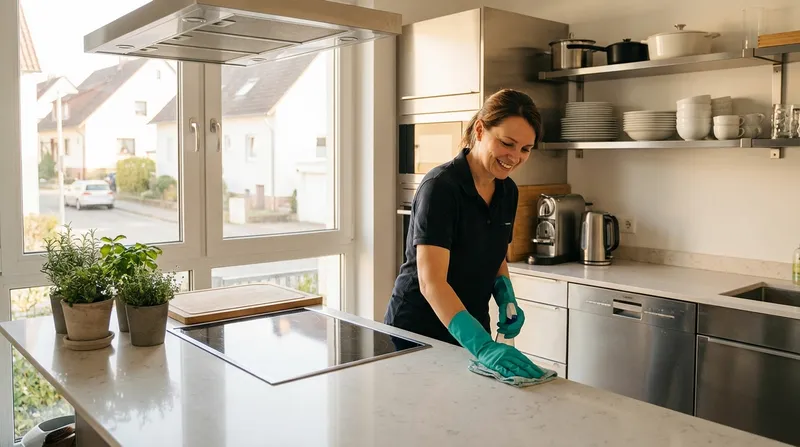
The tax credit works simply: the tax office deducts 20 percent of your expenses directly from your income tax. Not from your taxable income, but directly from the tax itself — that's an important distinction that makes a much bigger impact.
Here are the specific limits for 2026:
| Type of Service | Deductible | Max. Tax Credit per Year |
|---|---|---|
| Mini-job in private household | 20% of costs | €510 |
| Household services | 20% of costs (max. €20,000 expenses) | €4,000 |
| Craftsman services | 20% of costs (max. €6,000 expenses) | €1,200 |
| Total possible | up to €5,710 |
A calculation example: You pay your household helper €200 per month — that's €2,400 per year. You get 20 percent back, meaning €480 deducted directly from your tax bill. Add a gardener at €1,200 per year, that's another €240 in savings. And if you also hire a painter for €3,000 in labor costs, you save another €600 through the craftsman deduction. Total: €1,320 less in taxes.
Tip: The limits apply per household, not per person. If you live with a partner, you can only use the amounts once — regardless of whether you file jointly or separately.
Since the 2025 tax year, a stricter rule applies that continues in 2026: you must make every payment via bank transfer or card payment. Cash payments are consistently rejected by the tax office — including for care and nursing services, where exceptions existed until 2024.
This means specifically:
The background: the government wants to curb undeclared work. Anyone who pays cash loses the entire tax deduction — even with a proper invoice. No exceptions, no discretion.
Exception for mini-jobs: For registered mini-jobs in private households through the Minijob-Zentrale, cash payment of wages is still permitted. The household check serves as proof.
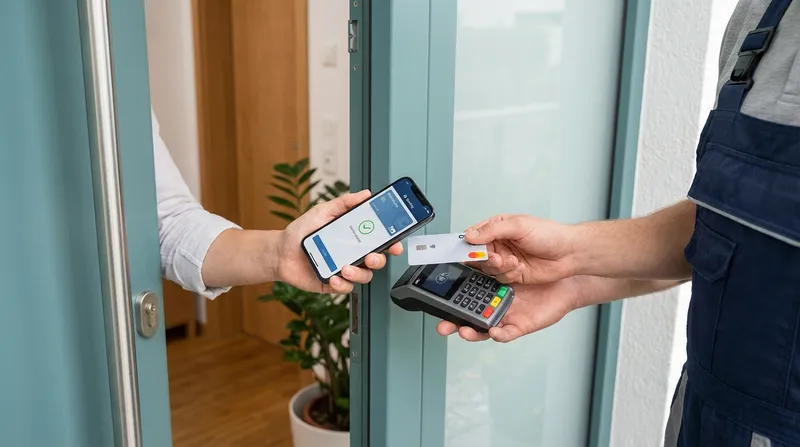
You don't need a tax advisor to claim household services. Follow these five steps:
Collect invoices — Make sure labor costs and material costs are listed separately. Only labor costs (including travel costs and VAT) are deductible. Material costs like cleaning supplies, paint or plants don't count.
Pay electronically and document it — Transfer the invoice amount or pay by card. Keep bank statements for at least four years.
Check your utility bill — Tenants benefit too. Your utility bill (Nebenkostenabrechnung) often includes items for caretaker services, stairwell cleaning or winter services. Ask your landlord for a certificate with the itemized amounts.
Fill out the household expenses form — In your tax return, enter costs in line 5 of the Anlage Haushaltsnahe Aufwendungen. In ELSTER, find it under "Other information and applications." Craftsman services go in line 6.
Keep receipts — You don't need to submit invoices and bank statements with your tax return, but you must be able to present them if the tax office asks.
Tip for tenants: If your utility bill isn't detailed enough, you have the right to request a separate certificate from your landlord. Many property management companies now include these amounts automatically.
If you regularly employ someone as household help, a registered mini-job is worthwhile. The earnings limit in 2026 is €603 per month. The minimum wage is €13.90 per hour — at maximum utilization, that's about 43 hours of work per month.
Why registering pays off:
The flat-rate contributions for you as an employer amount to about 14.94% of wages. You can claim these costs entirely as household expenses. Contributions are collected semi-annually via SEPA direct debit — in January and July.
Check out our detailed guide on the Minijob-Zentrale and household jobs for all registration details.

Claiming material costs. The tax office only recognizes labor costs, travel costs and machine costs. If your gardener charges €500 for work and €200 for plants, only the €500 is deductible. Make sure the invoice lists these items separately.
Paying cash and still trying to claim. Since 2025, the rule is absolute: no bank statement, no tax deduction. Even with a perfect invoice — anyone who pays cash gets nothing. The only exception is registered mini-jobs through the Minijob-Zentrale.
Claiming costs in the wrong year. The cash basis principle applies: what matters is when you paid, not when the service was provided. A December invoice that you transfer in January belongs in the new tax year.
Entering total costs instead of labor costs only. Many people enter the complete invoice amount. The tax office checks carefully and reduces the amount by material costs. In the worst case, the entire deduction is rejected if the invoice isn't itemized.
Forgetting the utility bill. As a tenant, you're leaving money on the table if you don't claim the household-related portions of your utility costs. Stairwell cleaning, caretaker, winter service, garden maintenance — these quickly add up to several hundred euros in deductible costs.
In the area of nursing and senior care, amounts can be particularly high. Outpatient nursing services, daily companionship or hourly senior care — all of this falls under household services, as long as the service is provided in your home.
Especially relevant for family caregivers:
Anyone looking for professional care or daily assistance for family members can find suitable service providers nearby on Helpful Folks.
Deducting household services from your taxes isn't complicated — you need proper invoices and must pay by bank transfer. With up to €5,710 in potential tax savings per year, it's worth collecting all receipts and entering them in your tax return. Whether it's household help, gardening, childcare or senior care: anyone who uses help should take advantage of the tax benefit. On Helpful Folks you can find service providers near you — and every invoice you receive is tax-deductible. Register for free now and find the right helpers.
Helpful Folks connects you with verified service providers — free and hassle-free.