
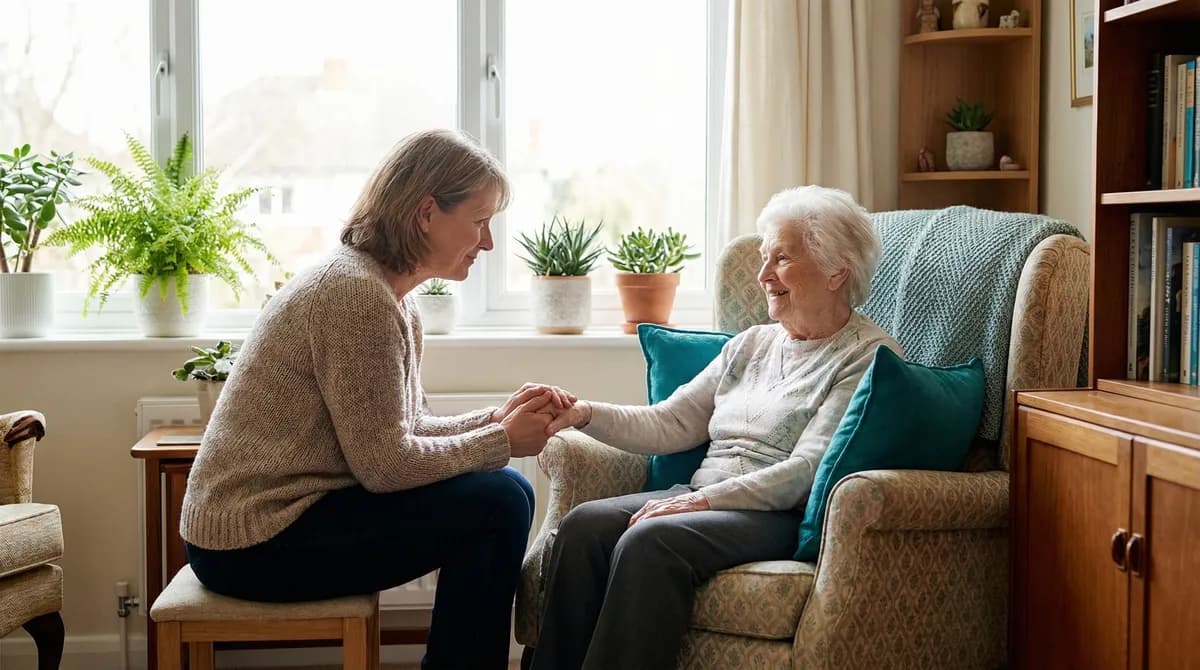
Home care in Germany: relief allowance, respite care, BEEP Act 2026 and senior companionship. All benefits and support options at a glance.
Helpful Folks Redaktion
Experts in Senior Care and Home Nursing
March 30, 2026
Are you caring for a family member at home and feeling your strength fading? You are far from alone — in Germany, over seven million people look after relatives who need care, and the vast majority do so without any professional support. Yet there are numerous benefits available that many people are unaware of or simply do not use. In this guide, you will learn which financial support you are entitled to in 2026, what the new BEEP Act means and how hourly senior companionship can lighten your daily load.
The scale of home care in Germany is staggering. At the end of 2023, nearly 5.7 million people were classed as care-dependent — and 86 per cent of them were cared for at home. More than half were looked after exclusively by family members, without any professional service at all. The number of people needing care has doubled in the past decade and is projected to reach nearly seven million by 2055.
Behind these statistics are people who deliver extraordinary effort every single day — often alongside their own job, raising children and running a household. The strain is immense: around 70 per cent of family caregivers feel severely burdened, one in three is completely overwhelmed according to a VdK study. Three out of four report emotional exhaustion, and a quarter have developed mental health conditions such as burnout, depression or anxiety disorders in recent years. Strikingly, over 80 per cent of family caregivers are women.
The problem is not just the physical work. It is the relentlessness, the lack of breaks, the social isolation and the feeling of never doing enough. But help is available — and it is worth taking.
Important: Seeking support is not a sign of weakness. It is the smartest decision you can make for yourself and the person you care for — because only someone who stays healthy themselves can be there for others in the long run.

The German care system offers a whole range of benefits specifically designed to relieve family caregivers. Here is an overview of the most important funding pots and their amounts:
| Benefit | Amount 2026 | Care Level | Details |
|---|---|---|---|
| Care allowance (Pflegegeld) | €347–990/month | CL 2–5 | Freely usable, for family caregivers |
| Relief allowance (Entlastungsbetrag) | €131/month | CL 1–5 | For approved care services, transferable |
| Respite + short-term care | €3,539/year | CL 2–5 | Combined annual budget, flexibly divisible |
| Care in kind (Sachleistungen) | €761–2,200/month | CL 2–5 | For professional nursing services |
| Day care | €689–1,995/month | CL 2–5 | In addition to care allowance, separate budget |
The relief allowance of €131 per month is available to every care-dependent person — including those with care level 1, who receive no regular care allowance. It does not need to be formally applied for; the entitlement exists automatically. Unused amounts can be carried forward until the end of June of the following year. And up to 40 per cent of care-in-kind benefits can be redirected towards hourly companionship — at care level 3, that amounts to nearly €600 extra per month.
The BEEP Act — standing for "Befugniserweiterung und Entbürokratisierung in der Pflege" (Empowerment and Debureaucratisation in Care) — was approved by the Bundesrat in late 2025 and brings tangible improvements to home care in 2026:
The combined annual budget is now standard. Since July 2025, respite care and short-term care have been merged into a flexible pot of €3,539. 2026 is the first full calendar year under this arrangement. You can freely decide how much to allocate to each care type — no rigid split required.
New invoicing deadlines. Respite care costs must be submitted by the end of the year following the care. Example: respite care in March 2026 → claim by 31 December 2027 at the latest. Claims from 2022 to 2024 expired as of January 2026.
Prevention programmes delivered at home. From 2026, care funds are to increasingly bring health programmes directly into home care settings — such as fall prevention courses, nutritional advice or exercise programmes.
Digital care applications (DiPAs) made easier to access. Apps and digital aids become more readily available and are subsidised by the care fund at up to €50 per month.
No prior care period required for respite care. The entitlement now exists from the day the care level is recognised — you no longer need to prove months of prior home care.
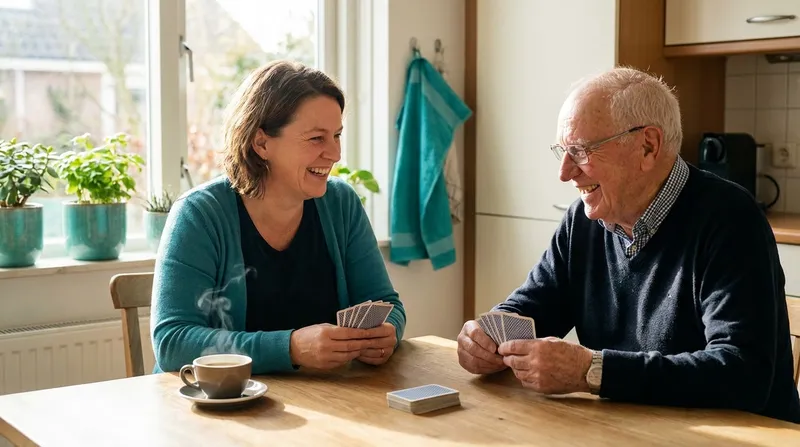
Many family caregivers think of relief only in terms of care homes or expensive nursing services. Yet there is a far more accessible solution: hourly senior companionship from everyday companions. On Helpful Folks you can find senior care near you — people who look after your relative with warmth and reliability while you take a breather.
What an everyday companion actually does:
Cost overview:
| Provider | Hourly Rate | Funding Source |
|---|---|---|
| Private everyday companion | €15–25 | Relief allowance, respite care |
| Approved care service | €25–40 | Relief allowance directly billable |
| Nursing service (hourly) | €35–55 | Care in kind, respite care |
The relief allowance of €131 per month already covers three to five hours of hourly companionship. Respite care adds further funds. In many cases, the care can be financed entirely through care fund benefits.
Respite care is one of the most valuable tools for family caregivers — and simultaneously one of the least used. It kicks in when you as the primary carer are temporarily unavailable: through holiday, illness, an important appointment or simply because you need a break.
Check your entitlement. From care level 2, there is an entitlement to respite care from the combined annual budget of €3,539. Since the BEEP Act, no prior care period is required.
Organise a replacement carer. This can be a professional service, a private companion via Helpful Folks or even a family member. For relatives up to the second degree, however, reduced reimbursement rates apply.
Have the care carried out. Respite care can be used by the day, by the week or even by the hour — up to 56 calendar days per year in total. When used by the hour (under 8 hours per day), the care allowance is not reduced.
Submit costs. Collect all receipts and submit them to the care fund. The deadline runs until the end of the following year. No advance application is needed — you can also claim respite care retrospectively.
Tip: Use hourly respite care regularly, not just in emergencies. A fixed weekly slot when a companion visits gives you predictable breathing space and prevents you from reaching your breaking point.
Are you sleeping badly because you check on your relative at night? Chronic sleep deprivation is one of the earliest and most serious warning signs. After just a few weeks of insufficient sleep, the risk of cardiovascular disease, depression and accidents rises significantly.
Have you hardly any social contacts left? Social isolation is one of the most common consequences of intensive home care. If you notice that you no longer meet friends, decline invitations or increasingly withdraw, it is a clear signal.
Do you react irritably and then feel guilty? Irritability towards the person you care for, followed by guilt, is a classic pattern of overload. It does not show that you are a bad person — it shows that you urgently need relief.
Are you neglecting your own health? Cancelling doctor''s appointments, forgetting medication, no time for exercise — when your own health takes a back seat, you are on the road to burnout.
Do you feel like it is never enough? No matter how much you do, it never feels sufficient — this persistent sense of inadequacy is a classic burnout symptom in caregiving.
If you recognise yourself in one or more of these points, now is the right time to organise support — not tomorrow, not next week.

Beyond hourly companionship, there are additional care formats that provide you with regular or temporary breathing space.
Day care: Your relative spends the day — usually from morning to afternoon — in a day care facility and is brought home in the evening. The care fund covers €689 to €1,995 per month depending on care level. The care allowance is not reduced — both benefits are available in parallel.
Short-term care: For up to eight weeks per year, your relative can be temporarily cared for in a residential facility — for example after a hospital stay or when you need a longer break. Costs are funded from the combined annual budget of €3,539.
Night care: Similar to day care, but for the night-time hours. Particularly useful if your relative is restless at night and you need uninterrupted sleep to function during the day.
Care counselling: Every care-dependent person and every family caregiver is entitled to free care counselling from the care fund. Make use of this service — the advisors know every benefit and will help you maximise your entitlements.
Caring for someone at home is one of the greatest challenges life can present — and you deserve support. The care fund offers more benefits than most family caregivers realise: from the relief allowance to respite care and the new flexible annual budget. Use these resources before you reach your limits. And if you are looking for a warm, reliable companion for your relative, Helpful Folks can help — browse the listings and give yourself the relief you deserve.
Helpful Folks connects you with verified service providers — free and hassle-free.