

How daily companions help with dementia, what they cost, and how to use the €131/month relief benefit to pay for it.
Helpful Folks Redaktion
Experten für Pflege und Betreuung
April 5, 2026
When a loved one is diagnosed with dementia, daily life changes fundamentally for everyone involved. The caregiving is intensive, emotionally demanding and leaves little room for your own needs. In Germany, around 1.8 million people live with dementia — and approximately 1.4 million family members handle the daily care. Daily companions can provide tangible relief: they come to your home for a few hours, engage and look after the person with dementia while you catch your breath. In this article, you'll learn what daily companions actually do, what they cost and how to use your care insurance to pay for it.
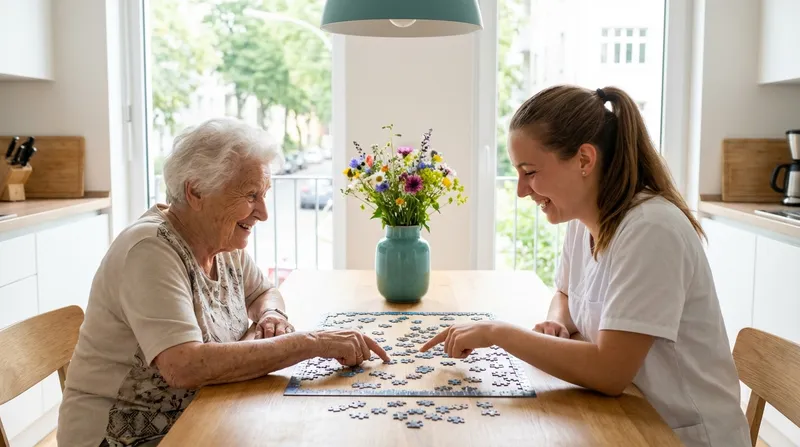
Daily companions (Alltagsbegleiter) are specially trained individuals who support people with dementia in structuring their day. They don't perform nursing or medical tasks — their focus is on engagement, activities and social participation.
Typical daily tasks include:
For you as a family member, this means: while the daily companion is there, you can run errands, go to the doctor, meet friends or simply have two hours to yourself. That may sound like little — but for family caregivers, this break is invaluable.
Every care recipient with Care Level 1 to 5 is entitled to the relief benefit of €131 per month. This amount is earmarked and perfectly suited to finance daily companionship.
How billing works:
Important to know: Unused amounts don't expire immediately. You can save up the relief benefit over several months and claim it until June 30 of the following year. For example, you could save six months of €131 and then finance a more intensive care phase of €786.
Tip: Make sure your daily companion is approved under state law (per § 45a SGB XI). Only then will the care insurance accept the billing. On Helpful Folks you can find approved daily companions near you.
Daily companions under § 45a SGB XI must complete a basic qualification of 160 teaching units. The training typically takes four months and covers:
| Component | Content | Scope |
|---|---|---|
| Theory | Dementia knowledge, communication, care concepts, legal framework | 160 TU (120 hours) |
| Orientation internship | Insight into care facilities | 40 hours (1 week) |
| Care internship | Practical work with care recipients | 80 hours (2 weeks) |
| First aid course | Emergency measures (max. 2 years old) | 9 TU |
No formal prerequisites needed — what matters is empathy, patience and respectful interaction with older people. Training is offered by various organizations: German Red Cross, Diakonia, Caritas, Johanniter and private academies.
When looking for a daily companion, ask for the basic qualification certificate. It confirms the person has the necessary knowledge in dealing with dementia.
Beyond the relief benefit, as a family caregiver you have access to the combined budget for respite and short-term care of €3,539 per year — from Care Level 2 onward.
Hourly respite care — ideal for dementia daily life:
Respite care doesn't have to be used in full days. You can also use it by the hour — for example, three times per week for four hours each. As long as the daily relief stays under eight hours, your care allowance is not reduced. This makes hourly respite care the perfect complement to daily companionship.
Calculation example: At an hourly rate of €25 and four hours per week, that's €100 weekly, roughly €5,200 per year. With the combined budget of €3,539, you can cover about 35 weeks — the rest you finance through the relief benefit (€131 x 12 = €1,572). Together, that's over €5,100 per year available to you.

Whether you're caring yourself or briefing a daily companion — these ground rules make daily life with dementia much easier:
Validation, not correction. When your family member says things that aren't true, don't correct them. Respond to the feelings behind the statement, not the content. "It sounds like you miss your mother" works better than "Your mother passed away 20 years ago."
Short, clear sentences. People with dementia often can't follow longer sentences. Say "Would you like tea?" instead of "Shall I maybe make you a cup of tea, or would you prefer coffee?"
Eye contact and touch. Language becomes increasingly difficult — but body language is retained longer. A hand on the shoulder, a smile or a hug often say more than words.
Routine provides security. A fixed daily schedule with consistent times for meals, walks and activities reduces anxiety and restlessness.
Patience with repetition. When the same question comes for the tenth time, answer as patiently as the first. Pointing out the repetition only causes frustration.
Music works. Songs from their youth activate deep memories that otherwise seem buried. Singing and listening to music are often the most effective forms of engagement.
Your own health matters. Between 40 and 70 percent of family caregivers develop depressive symptoms. Accept relief services — not as a luxury, but as a necessity.

Find more about financial options in our article on the 2026 care reform.
Daily companionship for dementia isn't a sign of weakness — it's a smart decision for both you and your loved one. With the relief benefit of €131 monthly and the respite care budget of €3,539, you have over €5,100 per year available. Qualified daily companions bring structure, activation and company into your loved one's day while you get the break you deserve. On Helpful Folks you can find daily companions and care services near you. Register for free now and find the right support.
Helpful Folks connects you with verified service providers — free and hassle-free.