

Spring is moving season! Find private helpers, save money, use our checklist — everything for your stress-free move in 2026.
Helpful Folks Redaktion
Experten für Alltagsdienstleistungen
April 2, 2026
Spring is here — and with it, moving season. Around a quarter of all moves in Germany take place between March and May. Mild weather, longer days and the motivation for a fresh start make this the ideal time. But a move can quickly become expensive and stressful if you don't plan well. In this article, you'll learn how to find reliable moving helpers, what costs to expect, and how proper preparation ensures you move into your new home relaxed.
According to an analysis by Deutsche Post, around 25.4 percent of all moves happen in spring — only summer edges ahead at 27.5 percent. Overall, more than 9 million people move in Germany each year, about 25,000 moves per day.
Spring has some solid advantages over summer:
Tip: If you're flexible, plan your move during the week. Saturdays are the most expensive and hardest to book. A Tuesday or Wednesday often saves 20-30 percent.
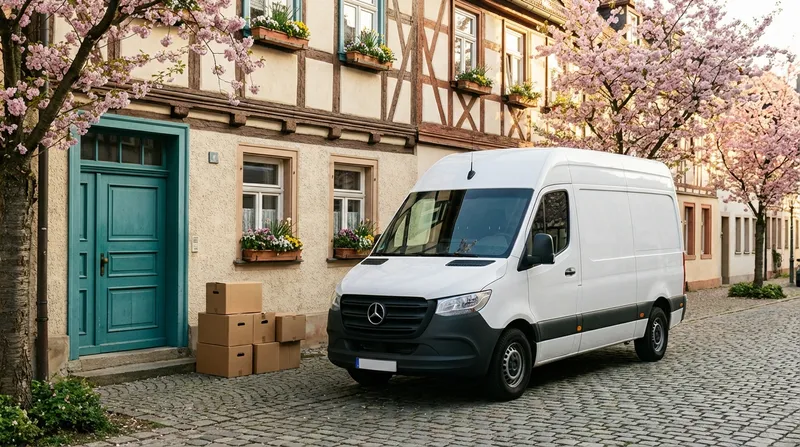
Costs depend heavily on whether you organize everything yourself or hire professionals. Here's an overview for 2026:
| Option | 2-room apartment (local) | 4-room apartment (long-distance) |
|---|---|---|
| Completely DIY (rental van + friends) | €150–350 | €400–800 |
| Private moving helpers + rental van | €300–600 | €800–1,500 |
| Moving company (full service) | €400–700 | €2,000–3,500 |
Professional moving companies typically charge €25 to €40 per hour per helper. A two-person team including a van runs €50 to €80 per hour. For an average 2-room apartment locally, expect about 4 to 6 hours — that's €200 to €480 in labor costs plus travel and materials.
Student moving helpers are significantly cheaper: they typically work for €14 to €17 per hour. With three helpers and six hours of work, you're looking at €250 to €300 — without the van, which you'd rent separately.
A well-planned move doesn't begin on moving day but at least eight weeks beforehand. Here's your roadmap:

You essentially have three options for getting support with your move:
Friends and family — The cheapest option, but not always reliable. Expect someone to cancel on moving day. Always plan for one or two extra helpers beyond what you need.
Student moving helpers — Through placement platforms you can find flexible helpers for €14 to €17 per hour. Booking is straightforward, and many students have moving experience. However, there's usually no liability insurance for damages.
Professional moving companies — The most expensive but safest option. Pros bring their own packing materials, know the procedures and carry basic liability under § 451e of the German Commercial Code covering up to €620 per cubic meter of cargo space.
On Helpful Folks you can find moving helpers near you — from private helpers to experienced professionals. You can compare profiles, read reviews and get in touch directly.
Tip: Always get at least three quotes before deciding. Check whether travel to and from the job is included in the price — this can significantly change the final cost.
Things break easily during a move. That's why it's important to know who's liable:
With professional moving companies, statutory liability under the German Commercial Code applies. Basic coverage is €620 per cubic meter of cargo space. For particularly valuable inventory — antiques, art, expensive electronics — consider additional transport insurance. Important: you must report obvious damage immediately upon delivery. For hidden damage (e.g., broken glass inside a box), you have 14 days to file a claim.
With private helpers, the situation is different: volunteer moving helpers are generally not liable for damages unless there's gross negligence or intent. If your friend drops the vase, you bear the cost. Check beforehand whether your household contents insurance covers moving damages — many policies offer this as an optional add-on.
For damage to the rental apartment — scratches on parquet floors, dents in the stairwell — your personal liability insurance typically steps in. Document the condition of both the old and new apartment with photos before the move.

Many people don't know that moving costs can be tax-deductible — in two different ways:
If you're moving for a new job or your commute shortens by at least one hour, the tax office recognizes the costs as business expenses. The moving cost flat rate is €964 for singles and €643 for each additional person moving with you (partner, children). Costs beyond that can be claimed in full with receipts.
Even for a purely private move, you can claim the labor costs of the moving company or helpers as a household service. This gives you a 20 percent tax credit on up to €20,000 in labor costs — maximum €4,000 directly off your tax bill. Requirement: you have an invoice and paid by bank transfer.
Read our detailed article about household services and the tax credit for all the details.
Before you start packing, declutter radically. Every item you don't take saves space in the van, carrying effort and real money.
Items still in good condition can be sold on classified ads, given away or donated to charities. For the rest, use your municipality's bulky waste collection — in many cities it's free or costs just a few euros. Register at least two weeks before the move, as appointment slots fill up quickly.
Not planning enough helpers. For a 2-room apartment, count on at least three strong helpers; for larger apartments, four to six. One person should always stay at the van to secure the load.
Packing boxes too heavy. A moving box should weigh no more than 20 kilograms — even if more fits. Distribute books and dishes across multiple boxes and fill with lighter items.
Not setting up a no-parking zone. If you live in the city, you need free parking right outside on moving day. Apply for a no-parking zone at the city office — allow two to four weeks and expect €20 to €80 in fees.
Not protecting fragile items. Mirrors, TVs and glass surfaces need extra padding. Old blankets and bubble wrap are essential. Label such boxes clearly with "Fragile."
Forgetting the old apartment. Handover protocol, key return and reading the meter — do this before the move, not after. Photos of the apartment's condition protect you in disputes over the deposit.
No refreshments for helpers. Anyone helping you carry things all day deserves at least drinks, sandwiches and pizza in the evening. It motivates and shows appreciation.
Leaving everything to the last minute. Starting to pack the night before leads to chaos on moving day. Begin at least two weeks ahead with the rooms you use least.
A spring move offers mild temperatures, good availability and often lower prices than midsummer. With solid planning starting eight weeks ahead, reliable helpers and the right amount of decluttering, moving day becomes significantly more relaxed. On Helpful Folks you can find moving helpers near you — straightforward, flexible and reliable. Register for free now and find the right helper for your spring move.
Helpful Folks connects you with verified service providers — free and hassle-free.